

Why We Need War
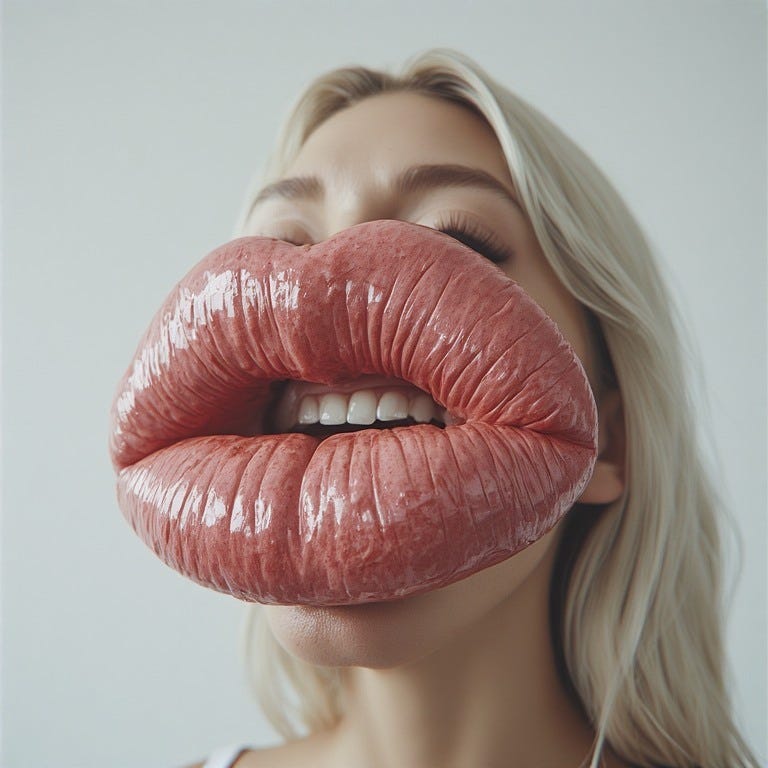
Let's workshop this poem about how a culture of aesthetic paralysis and synthetic perfection pushes desire toward the last remaining signs of life—until even small motions of the face become charged.

scent of the day: Fiore D’Ambre, by Profumum Roma
Fiore D’Ambre—a spiced-floral amber with not only top-tier naturals containing none of the autotune boosters of the growing monocrop of Taylor Swift perfumery seemingly hellbent on smoothening out the crevices of our brain (ambrocenide, amber Xtreme, norlimbinol, and so on), but also with a vintage feel that scratches my musty-antique itch quite nicely (and with a lovely feminine Oud-Sinharaja vibrancy instead of the usual drab brown that I actually prefer)—
opens with a narcotic pizzazz of Avon-powder florals (opium poppy, but also perhaps a civet-splashed trio of jasmine, carnation, and orris) enveloped in a combo of creamy-vanilla opoponax leather (like Shalimar) and soapy sandalwood incense (like One Man Show Oud Edition) with a twinge of fantasy honey made from opium poppies (which never happens since their alkaloids are toxic to bees)
and then finally—these first elements receding from the spotlight but continuing to hum for the fragrance’s long life of linearity—a lemon-almond musk marked by sweet-sour rosiness and patchouli-like earthiness ramps up until it becomes hard not to see this as a more balsamic sister of Habit Rouge especially given their shared spicy florals (jasmine and carnation mixed with clove and cinnamon, perhaps even cumin) and warm resins (benzoin, opoponax) and warm woods (sandalwood, cedar)—
the overall result being a fragrance that interprets the classic amber structure through a unique lens, as can better be seen when contrasted with Ambra Aurea and Ambre Russe (two major ambers in my collection):
(1) Ambra Aurea, which is largely a bruléed Ambre Sultan minus the spice rack and with a good dollop of ambergris to make for a cognac-smoky oceanic amber of monolithic naturalism, offers the densest and most unfiltered primal charred amber (bittersweet molasses, chocolately and with a caramelized edge);
(2) Ambre Russe, bringing a festive feel of airy circulation to a similar charred-amber-plus-ambergris profile, swaps out the dense and melancholy cognac with vaporous tea and vodka-champagne effervescence (the amber here less like molasses than like burnt brown sugar on a cut of birch-tar leather);
(3) Fiore d’Ambre, the classiest and most feminine of the three (a velvet-gloved hand dusted with opium pollen) and bringing in a posh citrus powder to brighten the overcast skies of the other two saltier ambers, takes the resin heart of Ambre Aurea (nearly molasses here on an analytical nosedive, even though holistically it seems more like light brown sugar with melted Amber Kiso butter) and uses grandma-makeup-desk florals plus citrus-honey (as well as perhaps even a soap-evoking smidge of musty oakmoss) to animate and aerate the composition in a vintage direction of European refinement (like a less growly Teatro Alla Scala by Krizia or Civet by Zoologist or perhaps also YSL’s Opium, which I have yet to smell but does share a lot of structure aside from the clove-patchouli-opoponax opium poppy accord).
Why We Need War

That latex look (lips stuffed
like duck liver, forehead
like a pet) now a norm of decency,

fuck-bot companies
can scale back biomimicry—until,
that is, deviant kids find kink

in facial mobility beyond
mere brainstem blinks:
crow’s feet of joy, brow arches of fear.
This poem, “Why We Need War,” operates as a compact but incisive satire of technological desire, aesthetic normalization, and the creeping dehumanization embedded in contemporary ideals of beauty. Through its compressed imagery, it traces a trajectory from cosmetic enhancement to artificial replication, ultimately questioning what is lost when human irregularity is smoothed into standardized perfection.
The opening lines establish a world in which exaggerated, artificial features—“lips stuffed / like duck liver,” a forehead rendered inert “like a pet”—have become not aberrations but norms of “decency.” The diction is deliberately grotesque. By comparing cosmetic augmentation to force-feeding or domestication, the poem reframes what is often marketed as enhancement as a kind of violence against organic form. Beauty here is no longer an expression of individuality but a convergence toward a uniform, engineered aesthetic.
This normalization of artificiality sets the stage for the poem’s speculative turn. If human faces increasingly resemble static, manufactured surfaces, then “fuck-bot companies” (a deliberately jarring term) can “scale back biomimicry.” The implication is that as humans approximate machines, machines no longer need to approximate humans. The boundary between organic and synthetic collapses not because technology advances alone, but because human self-modification meets it halfway.
The final lines introduce a counterforce: deviance, curiosity, and the persistence of desire for what remains irreducibly human. The imagined “deviant kids” discover “kink / in facial mobility,” finding fascination not in perfected stillness but in micro-expressions—“crow’s feet of joy, brow arches of fear.” What had been erased or minimized in the pursuit of idealized beauty returns as the new site of erotic and aesthetic interest. Imperfection, movement, and emotional legibility become fetishized precisely because they have been rendered scarce.
The title, “Why We Need War,” reframes the poem’s critique in broader, more provocative terms. War is not invoked literally but metaphorically, as a disruptive force capable of breaking cycles of homogenization and complacency. If society drifts toward sterile uniformity—faces frozen, expressions minimized, bodies standardized—then some form of rupture becomes necessary to reintroduce variation, unpredictability, and vitality. The poem suggests that without such disruption, even desire itself risks becoming mechanized.
In its brief span, the poem thus maps a paradox: the more we pursue perfected, controlled versions of ourselves, the more value shifts to what escapes control—movement, irregularity, the fleeting signals of inner life. What is framed as progress may, in fact, produce a hunger for the very qualities it eliminates.
satire, artificial beauty, cosmetic culture, technology and humanity, biomimicry, dehumanization, desire, expression, modern aesthetics