

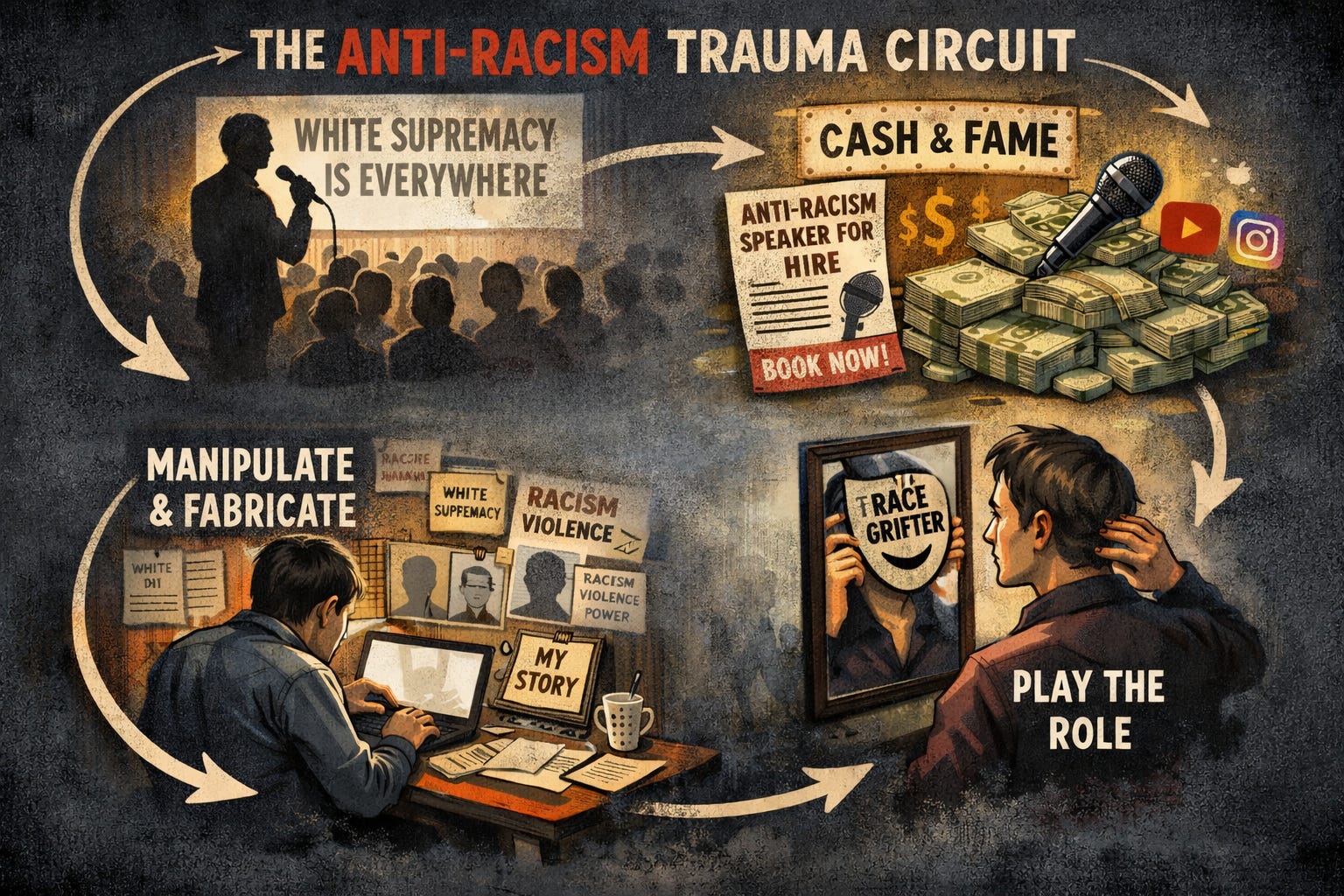
Trauma Circuit
Let’s workshop this poem about the recursive transformation of trauma into branded narrative, where self-surveillance and moral justification begin to merge.

scent of the day: Kinamantan, by Ensar Oud
A strange concoction: gray-green zest bitterness of Qi Nan (here with ginger zing, but without the spices) plus gingivitus earthy mint of Tigerwood that you feel in the sinuses and, especially from afar, a juicy-fruit gum somewhere between L’heure Exquise and Jubilation XXV. this can come across, despite the fact that no vetiver is listed, as an artisanal cousin to Tom Ford’s Grey Vetiver—only using something more like the ruh khus of Layers of Jade or Vetiver Nocturne and presenting us with several jarring tensions that the Tom Ford’s much more sober and staid composition definitely does not give us: wintergreen gum yet pink bubblicious (tigerwood and clove meets what seems tolu balsam and blackcurrant and opoponax), garage-band muddiness yet studio-production ethereality (hyrax and oud meets black ambergris and Tibetan musk and Kashmir musk). Ash in base reminds me of Myths Man./
Trauma Circuit

On loop you retell the horror,
clean as branding:
“a personal sacrifice”—

you whisper
to the role-auditor within,
that daimon whose doubt grows

with each speaking fee—
“to build a future
where no one else will suffer.”
“Trauma Circuit” is a compact poem about the conversion of suffering into vocation, identity, and performance. Its central subject is not trauma itself but the recursive economy that forms around its retelling: the way an original wound, once repeatedly narrated in public, can harden into brand, script, and self-justifying mission. The poem’s title is exact. A “circuit” suggests both repetition and transmission—something electrical, something routed, something that keeps current flowing by never quite breaking the loop. Trauma here is no longer a singular event in the past; it has become an ongoing system.
The opening lines establish that system through the phrase “On loop you retell the horror.” The horror is not denied or trivialized. What changes is its mode of existence. It returns through repetition, and repetition cleans it up. “Clean as branding” is the poem’s most incisive phrase. Branding carries a double charge: it evokes both scarification and marketing. The original pain has been rendered legible, streamlined, and usable. It is no longer raw but polished into a recognizable narrative unit, something fit for circulation before audiences. The horror remains, but in mediated form—purified enough to travel.
The second movement turns inward. The speaker addresses a “role-auditor within,” a remarkably rich phrase suggesting an internalized evaluator that measures authenticity, consistency, and perhaps marketability. This inner figure is called a “daimon,” giving it both classical and psychological resonance. It is conscience, familiar spirit, and prosecuting intelligence at once. Crucially, this daimon is not soothed by repetition. It grows more suspicious. Its doubt increases “with each speaking fee,” meaning that the monetization of testimony intensifies rather than resolves the ethical problem. The more the story is rewarded, the more unstable its moral ground becomes. The poem is therefore acutely sensitive to the conflict between witness and commodification: one may speak in good faith and still feel corrupted by the conditions under which one is heard.
The quoted justification—“a personal sacrifice… / to build a future / where no one else will suffer”—reveals how this economy sustains itself. The repeated retelling is cast as noble burden, something endured not for status or profit but for collective good. The poem does not entirely dismiss this claim. It may be true. But the whispering tone matters. This is not public declaration but private reassurance, spoken to the internal auditor whose skepticism cannot be fully silenced. The speaker must keep explaining the moral purpose of the performance because the performance itself increasingly invites doubt. In that sense, the poem is about ethical slippage: not hypocrisy exactly, but the way sincere mission becomes entangled with incentive, applause, and self-construction.
What makes “Trauma Circuit” so strong is its refusal of easy judgment. It does not sneer at trauma testimony, nor does it sanctify it. Instead, it isolates the psychological toll of turning pain into public labor. To survive trauma is one thing; to become professionally legible through it is another. The poem understands that the same act can be both altruistic and self-serving, both necessary and deadening. The “circuit” keeps running because there are audiences, fees, and futures to justify—but also because the self has become wired around this repetition. The horror is retold to help others, yes, but also to maintain a role, to answer the daimon, to keep meaning from collapsing.
In just a few lines, the poem captures a distinctly modern predicament: the transformation of suffering into platform. Its brilliance lies in showing that the deepest conflict is not between public and private, but within the self that must keep deciding whether its witness is still witness—or whether it has become something cleaner, sharper, and more profitable than pain was ever meant to be.
trauma narrative, branding, commodification of suffering, public testimony, ethical conflict, repetition, identity formation, speaking circuit, self-performance, modern lyric poetry