

Subway Restraint (Round 10)
Let's workshop this prose poem, set to the song "American Girl," about a clash between a black man late to a job interview and "antiracist" protesters who will not let him off the subway train.

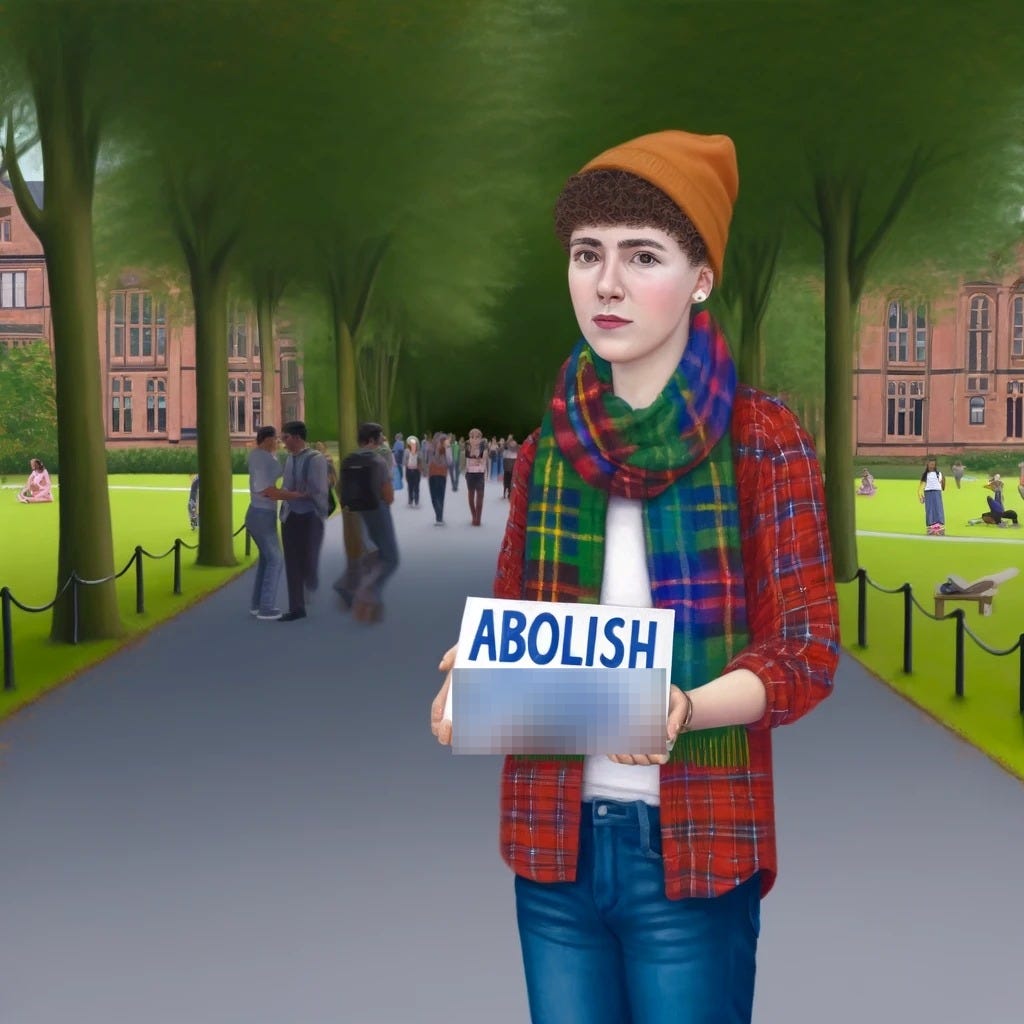
See asterisk commentary below for why I am now redacting my photos. TDLR: perpetual infants get perpetual frost
scent of the day: Nose Rest Day
*This is now even sloppier. But I wanted to give this more of a story arc and show the nature of the man’s polemical rants as they would loop to friends and family.
Subway Restraint
The time has come. You are trapped. Stinking with the bodies against you each way, pressed suit disheveled—calling yourself late understates the gravity. Who could have known, kissing your girlfriend goodbye with interview nerves, butterflies for the future, that the time would come now? But it has. That is how life works. Everyday—sunrise, sunset—the ambulance dopplers elsewhere. That is until one day you find it coming for you.
Serve the long game. Do not jump right to throat daggering that lead cunt, shrieking as her arms spread to restrict you and the bodies behind you from exiting the split door of the subway. Your first move, seductive as it no doubt is, should not be to impale that vein-flared neck of fanaticism with your “Urban Pal” pocket push dagger—its blade just over two inches of larynx love, double serrated for bleed-out rip backs meant to thwart repair (and cheaper than a gas-station sandwich, for whatever it might be worth to say, on bladehq.com).
Breathe. Swamp ass and mildewed underwear, mildewed enough to smell the holes and blown elastic, imprint the molded plastic with the funk of a track-mark jasmine that had made the worst life choices and a meth-mouth tuberose that had been double dipped as toilet paper. Over this hobo base, over as well the commuter heart (a coffee halitosis fed into sulphuric frenzy by the sugars of gum and lifted into full Fantasia fanfare by the radioactive autotune fixatives now as obligatory in Sephora fragrances as the equally-unwashable twerking is at the Democratic National Convention)—over it all you can smell your own adrenaline sweat (cold and sour, like finger pads after rubbing a coin or a car key), this metallic top note synergizing with the brakepad scorch into a rusty aldehyde that coats the mouth in a fuzz of iron fillings. But continue to breathe. Raise your nostrils above the urban crotchrot, above the rotten eggs of sump water stagnant in the trenches below the rails—all of it today kicked into a roil by the dank-dog mustiness of fabrics and footwear soaked from the rain in the streets above. You are a tall man. Appreciate the space you still have in the claustrophobic crush.
Restrain yourself. You know now, you can feel now (after decades of laughing away the ridiculous numbers in murder news), how death can wash up in indolic glory on the autopsy slab with stab wounds nearing—if not well into—triple digits. But the time for blade gratifications, multiple climaxes at the cost—if you do it now, like some monkey—of a life ruined by the gavel, might show itself with some patience. You are not a fucking monkey. Unloading after a wait is better anyway—especially an agonizing wait where every nerve screams for action, every gland mewls for milking, like engorged tits barred from the mouth of the crying infant. Think of the goo building. The inner child in us all, no matter how old or wise we become, wants to witness as much ribbon bloom from the popped cyst, sweet blips of curd along the way—the bigger the coiled pile of cottage cheese at the end, the better. Think, then, of your pride—as if again showing your mother the height of the pile of mashed potatoes on your plate—when you get to behold the destructive mass of your freed burden.
Shoves and slithering words, hold these back as well. You stand above the rabble. Let the seething fury of your stolen big day mount, right up to the gills, as the chanting mass behind this bitch—“No! One! Gets! Off!”—hammer-fists away any bold hand trying to pry open the panels from within. Feel the spittle spatter on your face, the inadvertent mist of justice-warrior apoplexy, grow into purposeful thwacks as you insist to be set free from the metal trap of this neo-witch hysteria. Feel them grow more aggressive, her forehead rammings—right into your heart, the cunt, every time the panels open enough. But stay your hand. We have waited for the right ambient conditions too long to blow it too early. Have we not?
Time dilates for us. Accept, in the growing splay of seconds, the futility of your plea. It can be hard, yes—like trusting that the sea will buoy your body if only you let go of tree-mammal tension of white-knuckled toes. But trust that the futility is a friend. It grows the potency of your ferocity, the need for your ferocity. Come the time for execution-style rejection of the entire modern farce, the futility will turn you invincible. It will turn you invincible even to bullets for a time, so long as right now you stay rooted—rooted in that narrow space where you work yourself up for having been made a sardine and yet where you, wanting like any heart breaker to “make it last all night” with this American girl in her slouchy beanie, conduct yourself as if on an empty beach somewhere in the breeze.
Every smartphone glows a weapon of mass judgment. But neither this nor all the corner-nestled CCTV cameras can excuse slipping away into some private pocket of psychology. It is all to easy for a human to get caught in the vent of fantasy: if only I were wearing one of those old-school carnations on my breast pocket, squirting acid like The Joker. If anything, let the nontruth of such counterfactuals further fuel your frustration. For ultimately you must go to work. When you do go to work, however, give your defense attorney—hands tied by whatever scraps you leave behind—at least a little to work with. Think of it that way. Thinking of it that way will keep your will from buckling even as it serves to titillate your will with the promise of a later chance to buckle—perhaps even crumble, delivering you into painless disindividuation: oneness with the World-All. This is about edging, okay?
Try to lock in eye-contact with that one officer in the sea of phones raised, several of their owners screeching at you “Don’t you fucking touch her!”—a baiting formula as transparent, of course, as those feline-heat growls of “Don’t you dare cum in me!” Throw in a “Please help, officer” or two: the film never stops rolling. If you really want to piss yourself off, say it a bit too soft. The officer will fail on cue, either way, to safeguard your free passage. Is this not, after all, a non-castle-doctrine state where squatters have rights over your home (such that you cannot remove them yourself without legal repercussion)? Is this not a duty-to-retreat state where, although no one raises an eye about calling in an exterminator to spray paralyzing roach poisons, burglars have won settlements for injuring themselves on the job merely because you set a rated-R McCallister boobytrap (a floorplate, say, that triggers the release of a neurotoxin dart that paralyzes the diaphragm) to deal with a chronic problem—or even, if only on rare occasions, merely because of a broken ankle caused by your wobbly porch railing or a concussion caused by your shoddy weekend-warrior wall mount of the 8k flatscreen with too much street value for any BIPOC to be equitably expected to resist, especially when flaunted (day in, day out) through arrogant bay windows pointed curbside in a fuck-you to color?
Besides, the officer is white. He is white and, even though you have the asset of being darker skinned, he fears that career-shattering r-word in later press. How could he not? The press, “legitimate” press, has adopted the buzz words and speech patterns of campus activists: news anchors, for example, stressing (with not even a hint of understated irony) the adjective “black” as a moral-bludgeoning means to heighten the shut-it-down force of their words (“Understand that you are talking to a black woman!”)—exactly as in when, to quintuple down on the impression that blacks are especially precious (such that mistreating a black person is more heinous than mistreating a non-black person), the white “ally” barks at the professor “Did you just tell a black man where to sit?” or the black student snipes at the white professor who challenged her opinion “Are you seriously calling a black woman wrong?” (both examples invoking an emotionally and historically charged context that makes people second-guess the morality of an otherwise mundane act, cranking up the volume on race to elevate its seriousness even when race was not a factor). So no, the officer—like the countless professors, paralyzed (were it not for stutters and perhaps even tears)—is unlikely to do anything (even in your favor). Trapped in a narrative the man never wrote, the stakes are too high. Is not this mob, after all, anti-Nazi? Sure it is, at least by the look of all their signs: “fuck nazi scum”; “fight antiblack killing”; “white vigilantism = fascism / black vigilantism = freedom.”
You could declare “I’m a black man.” Invoking race in that way usually gets whiteys like this in check. They know, after all, who the fuck is king. But you have integrity. You have refused taking any knowing handout. That would be giving in. Lesser men would have given in. You, on the other hand, would rather suffer than accept a concession you consider unearned. You would rather die—because, yes, that is what this ultimately about—than participate in what you know to be a system of lies and injustice. You have such a magnitude of negative respect for these powers, the true powers that be with the platform to keep denying that they are the true powers that be, that you are not even tempted. Perhaps you are too hardheaded. People have said it. But you are you. And that is admirable. It is a hill you will die on—again, that word. People type comments on social media but they are not willing to die. They are not willing to go out blasting, taking their enemies with them to the death before the luck of birth. You are. So good shit, nigga.
Declaring “I am a black man. You are blocking a king”—even if hitting exactly the right emphases on “black” and “king” (mere apposition like Spinoza’s Deus sive Natura)—would not even work, though. Socrates easily could have escaped his prison cell. You cannot. This a major city. People here know there are good blacks and bad blacks, the ones infected by the contagious disease of whiteness. They make finer grain decisions unlike in more suburban areas where the woke white will be like “Let the king pass” if only in the form of ushering you away like secret service tasked with protecting the most precious supercitizen, innocent and entitled.
There are also plain logistics to consider. It breaks the seal if they let you go. So even if they want to respect their king, it is for the greater good—it is for the benefit of you, a moral superior—to keep you trapped. And perhaps this frustration will wake you up to the slaughter of kings and queens. That could be their rationalization too. And if nothing good—no awareness, no turn around—comes of causing you discomfort, they could always chalk it up to unfortunate collateral damage—a mere drop, they might tell themselves, in the bucket of hell you must live every day here in triple-k Amerikkka out to get you as soon as you step out the door(even though in truth America is the very heart of a Western culture that has not only best articulated, better than any other ever on Earth, why racial discrimination is wrong but has best fought, better than any other ever on Earth, to end it). They would call it collateral damage, yes, to a higher cause just like in Ellison’s Invisible Man, still your favorite book since college, where the Marxist organization (the Brotherhood)—seeing, like no doubt this snowbunny slut in front of you, black suffering as combustible raw material—stirs up Harlem riots as part of an agenda, eerily similar to the real life situation where like organizations tried to create a massive black welfare dependency, to tank the government.
And speaking of Invisible Man, there is that scene where the Marxist white bitch—always the white cunts, huh?—says “Don’t you think he should be a little blacker?” Same goes here. You are not black enough for either the cause or to expect to get a free pass. High yellow tones like this do not command the respect. You need to be black black to wield the word “king” in a public arena. Yeah, perhaps in a dorm room getting high you can make the room walk on eggshells around you like you are Henry the Eighth. But in this grand public spectacle, no way. Face it. You do not possess that brand of blackness that has the white activist bowing low to tongue kiss Timberlands in a campus wedding filled with one-way vows: “I will work to repair the damage of my whiteness”; “I will tolerate any discomfort on the path to equity”; “I will never speak over a black person”; “I will never deny black truth”; “I will do everything in my power to abolish whiteness”; “I will not weaponize the police against black people”; “I will redistribute my unearned advantages”; “I will never call reparations ‘looting’”; “I will seek to understand more than to be understood”; and so on down the restorative justice line. Look at you, nigga. You do not even have dreads.
Even if you were jet black it might not even matter. We have already moved on to the next cultural hierarchy. You know each day you grow into an outdated commodity. For now at least, until perhaps the wheel turns back around, the mob—and thereby Disney, the weather-vane of the herd—has passed the high water mark of Black Panther. The FBI and universities have surely toned down their “How To Be Less White” learning modules, mandatory for compliance. It has been one or two Oscar ceremonies already since the last time any speech had to involve a star, usually another white cunt, doing what a white cunt does: crying at the podium about how unfortunate it is for black families to have to give their beautiful black teen, a king-in-the-making if only he can survive open season, what has become known as “the talk”—the former definition of the talk, which concerned the birds and the bees, having been supplanted, of course, by the more urgent issue of protecting as many black young men as possible (and “good riddance” many will say not just because sex discussion is already covered by the hip hop tracks that explain when to insert the Perc30 rectal suppository but because, think about it: “the birds and the bees,” that phrase, sounds as white as the surname “Smith” and thereby as antiblack as apple pie and old glory). It has to be a year or so, perhaps more, since the last movie—was it Tom Hanks?—where we are hit with that pathos-pulling scene where beautiful black parents must sit their good black boy down, a boy in no way posting pictures of himself with semiautomatics on Instagram, and give him the talk, the talk about how he must say “Yessa” to every officer and keep his hand on the wheel and never talk back and always announce he is merely reaching for his wallet; the talk about how he must say “Yessa,” in fact, in such an old school plantation way that—and here is the ghoulish conspiracy behind it all (but that is Hollywood for you)—young teens, naturally rebellious, will know exactly the way to assert their defiant identity: engaging in the very noncompliant behaviors that increase the odds of another news spectacle to keep the money-making cycle going. Ellison was not stupid.
The trans cause is in the foreground now. Oscar winners not only flaunt their trans kids like handbags (“So brave isn’t she?”) but are damn sure, when they thank their parents in the speech, that they use the term “gestating parent” for mother and “non-gestating parent” for father. And when in the post-ceremony interview they are called “brave for using these inclusive terms in such a public way” they will be damned sure to work in how the male swimmer in the news, the one in female drag with much more than lats and traps busting out of the singlet, was “so brave” for “absolutely crushing the other girls” in the competition—the most confrontational starlets preempting the bigoted response on so many tongues scared for their careers by saying: “Those assigned female at birth are just gonna have to get faster huh?”
And now the undocumented cause is just starting to get going. On the horizon—perhaps around the time we might expect Disney to release Mexican Panther (the writer who suggests Mexican Cucaracha instead, even if done completely innocently, fired on the spot because everyone else, especially the white cunt bitch sluts, feels “uncomfortable now” (and perhaps in part because it hits on a truth: how the illegal scurries, under and over, in the secret of night in a way remarkably similar to the roach)—we are bound to get Oscar winners who will make their drop-the-mic comment “No one is illegal on stolen land” even as they themselves own property gated and ready, the scum fucks, to call cops on any indigenous person who tunnels under just to grab a quick bite from the fridge (not any hamper sniff session jerk offs or anything).
So what is to be done? Plead to the mob. Remember: this is a marathon of baby steps. Plead—if only for the lenses. Plead through your teeth and muscles clenched by the taunting yells. Plead for someone within the drumhead jury, someone within the raging pack savoring your submission, to empathize with your humanity. Know all the while, again, that it will be in vain. And know that even if it were not, and even if it were clear by some magic that the efficacy was not a function of your skin, that would just defuse the pressure behind the cork pop yet again as it has done for too long now—yet again tempting you into quietism, into ignoring the life-redeeming call to pop off. How many times have you put your tail between your legs as you pussyfoot around a world of monkey justice? That time is over. This is a call to action.
Take on a pitiful tone of a meek victim. The tone, no, is not out of any realistic hope to draw forth enough compassion for your release. Things have escalated past that point. It is to bait them, stoke the appetite. Crowds lust to stomp the downtrodden, polished mirrors to their cruelty. It is out of a desire, moreover, to increase your coiled energy for lashing out at what will thereby swell beyond a ramming wall against free passage to your once-in-a-lifetime interview—swell into a polished mirror of your patheticness (smash-beckoning for you as well, however much it reflects calculated performance).
Plead your urgency. Plead with hopeful expectation since you—the you in some other hemisphere, so to say—well knows that hopeful expectation is ridiculous here, which only fans the building torrent: a broken record, yes, but hypnosis (especially self-hypnosis) works on humans. Explain the critical nature of your interview—a self-imposed torment, since it reminds you of all that is going down the drain (swirling just out of reach like in a nightmare). Explain it, much more importantly, since you owe no explanation; since only a bitch-ass-punk would give an explanation at this time—and yes, you are going to have to make up for being one. Keep your decibel just below their cacophony—a self-imposed catalyst to tap further into the mitochondrial amphetamine harbored within each cell. Even lie and say your wife is in labor, giving the horde all the chances in the world—all the chances to deny you still and thereby add grist to your motivational mill.
Scan the officer’s face once again. Scan back to the young zombies, mostly white and desperate for purpose in the potential virality of doing what is said to be “for your own good,” for your own good as “a black male in a society that has declared total war on black bodies.” You read the headlines. You listened to the news. And yet you still chose the subway. The protest is over the death of a martyred lunatic whose unruliness and death threats to passengers landed him in the chokehold of a marine who, for whatever it might be worth to say, received cheers from black commuters in danger and death threats from mostly-white “antiracists” in cyberspace. Scan their faces—scan, scan, scan for a flicker of reason. Try to reach any lucid eyes beyond their algorithm lenses. Even though the race card has already been pulled just looking at you, vocalize your blackness. None of it will make a difference, of course. But unblinking cameras roll for court scrutiny.
Only the best of men, after all this edging, can keep resisting. Do the following exercise if you feel you are going to blow your load too soon. For what you are after is too cook in your own juices, low and slow, as long as you can.
Move your lower jaw to the left: breath in and then out while holding it there. Now move your lower jaw to right: breathe in and then out while holding it there. Place the tip of your tongue to the roof of your mouth: breath in and then out while holding it there. Raise your shoulders slowly as you breath in and then, as you breath out, slowly bring them down. Repeat if you need to.
So where do we go from here? Do we go scorched earth: sticking her smug neck with a poison syringe—antifreeze, bleach, isopropanol, insulin—or even just a brutal headbutt into her nose? Or do we ease in a bit more, giving the attorney more to work with than just the black card (a trump card in typical situations) in case you make it out? Run through the latter first.
Perhaps pivot off your meek presentation with a surprise snatch of a phone glowing in your periphery. And then, as you dash into the train’s recesses, hypnotize yourself to think your sole life-on-the-line mission is to pulverize the phone: as many fragments as possible. Even if it does nothing to help the free flow of bodies, at least you can claim this victory. Admittedly, that is too small a victory to assuage your apoplectic blood pressure. But perhaps the owner will chase you down (into your web), which will provide a pretext for the dagger’s sting should any hands be placed on you.—No, strike that. Rewind the reel.
Start back at the door. Make sure you have a belt can of bear mace (much better than some comic-book carnation and much more realistic and wieldy than a hypodermic needle taken from your diabetic father). Go for the highest Scoville you can get (five million) and whose stream extends over thirty feet (udap.com)—you are welcome. After the cadaverous smiles of mockery press closer, after more and more spittle flies into your mouth and eyes—peel back the safety catch. Remember, it is you who should be spitting in her face. She is the very temptation of the victimhood mentality ruinous to black kind—a temptation for all people given that it provides an aura of purpose and gravitas while also a golden ticket not only to sidestep hard work and accountability for past behavior and future fate-carving, but also to extort and abuse and manipulate one’s purported victimizers; a temptation especially for blacks given that it affords them Lord-of-the-Rings level grandeur as part of a longstanding communal struggle for justice against “the man,” an ancestral crusade for payback against the ever-shifting “powers that be.”
After sternum rams get harder, after the officer turns a blind eye to your pleas of due diligence—unleash the chemical inferno. What would be the valor of protest, beyond just the valor of having a view, if there were no risk of baptism by liquid fire? Direct the maelstrom right into her face—even slipping in a couple, or seven, canister punches to that cunt mouthpiece—and then over everyone. Refuse to free the trigger as the doors finally close, leaving just enough room for you to spread every last bit of caustic fog.
Let the doors close for protection against the underground gas chamber of your creation. The dagger, scorching a blurry halo around your phoenix form, can then step into the limelight—and righteously so (given the interview, given your own seared blindness)—if any sleeper agent tries to restrain you. Even if you cannot see, even if your main concern is clearing a path, try at least to hear the writhing of numbers on the other side of the glass. There is no guarantee, despite what protestant-work-ethic Americans like to believe, that all your efforts—all your baby steps of patient calculation—will be rewarded with a not-guilty sentence. Give yourself something, that rich umami of pain and panic, to play back. Indeed, you might even be killed today. Savor what you can.
Instead of going the mace route, you could just hold the dagger out from the headbutted spot on your chest and walk forward. Confront the slouchy beanie clone, tattooed in bought exoticness, with a stark choice. Test her resolve. Or perhaps even better, you could walk forward with a bleach-filled syringe. That might not be such an unreasonable option after all. Among those Shakespearean-era audiences who lobbed tomatoes or cabbage or fish or rotten eggs at the actors, surely at least some of them carried into the theater something from home. And so could you! The problem is, others among the swarm would no doubt swat away any such device. The bear mace strategy still crystallizes, then, as a more satisfying and yet prudent course, balancing both defense and offense in the chaos of the moment.
Edging cannot last forever. Edging would not be edging without release. Containment must eventually fail. Toward jouissance—that was the trajectory. You are not God. You cannot run all the options. The bear mace strategy is best. But you knew this all along, did you not? Do you have a syringe? No. The mace and then, when it ended, the only other device you brought along to the theater: the push dagger—you knew before swiping the Metro Card, did you not? And yeah, think of how good it would be to clock her with that can. If you could have skull fucked her to death as an infant you would have” “How’s this for a minority report, little snowbunny bitch?” But you cannot go back. You unmake this cunt by filling her sex-sleeve form with nut.
You are tired of it. You have been tired of it for too long. You are tired of mental slavery packaged as freedom, dependency packaged as cool. You have waited for it to blow over. It waxes and wanes, fine. But does it ever blow over? No? There are too many bested interests. This is climate, not weather. You are tired of being told you have to have this or that from white people in order to survive here. You are no slave in the basement of a torturer who remains your ownly source of food. Do not believe the hype! You are no panda, driven to near-extinction by human encroachment and habitat destruction and yet surviving almost entirely due to human-funded breeding programs, artificial handouts, and government-protected reserves. You are tired of the evangelizing, the incessant belaboring of the point from both white hos and every Whoopi on TV as if one day you would fall to your knees and finally confess to their teary applause. “Yes, I admit it. My PTSD worsens every second I have to spend in world that has declared total war on the black body and the black spirit. I gaslit myself. I said my failings were mine. I did not want to face that it was the white man behind it all.”
Fuck this cunt. You are tired of being told you cannot do it on your own. Fuck her puppets too. You are tired of black people mouthing these words, these antiblack words of perpetual leaning and dependency, in the name of black power. The militancy with which they insist that black fate is in the hands of white America, that antiblack racism means that black people cannot make it here on their own (a lie that would be hobbling, self-defeatist, even were it not a lie), does not make that insistence pro black. It is antiblack. Dependency is a loser’s game. Begging can never be shined into empowerment, at least any empowerment that rises above that of the sleazy craftiness of guilting society to giving more freebies—a craftiness that has now stooped to lies since black people enjoy the same about of freedom from antiblack persecution as anyone else (at least when we delete the hobbling in the form of help that comes from white society.) The mask is see through. You know who the real Uncle Toms are in this twilight zone. They will never break you, at least in the way they want.
They will pay. They do not know you. They will pay for not knowing you. You are not a doormat. You are not the center. We are all in this. Your role is vigilante. You are not God. You must have a style. And the tentativeness to own your style has given you the style of a doormat. That ends now. You need to make it end good. Flowers bloom in all kinds. You are a dangerous flower. It just took you a few decades to bloom.
You need to hit that cunt bitch in the mouth with the edge of that can with all your spiritual might. Mothers can lift cars when their babies are trapped. That is where you must go. Dig deep. And you can because this is bigger than you. Cunt comes in like a helper of black people. She is a liar. She is a poisoner. She talks about an antiblack agenda in the West. But the best evidence for such is all their efforts fight against that agenda, fight against what fake-progressive money-hungry clout-chasing snowbunnies like her call an “ever-growing white supremacy.” Remember all the hurtful help she has given your people. That will increase the power of each strike into mother-protecting-her-baby proportions.
She would blame all black failure on “the oppressive chokehold of white supremacy.” And look what that does. It allows blacks to wipe their hands of any complicity in their failures and instead fault the nebulous specter—a lie. And what does that then do? That stultifies black agency and black dignity, which itself leads to widespread underperformance in so many domains that it would almost seem there really was an antiblack chokehold. Fuck this cunt. She would see you as a sad case of “internalized whiteness” just because you refuse—even though it meant years of being called “Jiggaboo Uncle Tom,” “race-traitor-ass nigga,” by blacks under her spell—to repeat and repeat her ghoulish gospel, the macabre mantra and downright lie, as to how much blacks have been and continue to be victimized (and hence to how deserving blacks are of inferiority-ossifying sympathy perks, pity-driven privileges that excuse them from the responsibilities requisite for human flourishing). She would see you as a puppet of the white man for rejecting the idea that victimhood is the beating heart of black identity, for insisting that blacks have a personal say in their destiny and have all their opportunities open to them. She hates you because you encourage black people to free themselves from her grievance hypnosis, free themselves from the plantation of dependency that hypnosis keeps them on. Smash this cunt for that! Smash her for siphoning away what little sense of agency black people have. Smash the clout-chasing snowbunny slut for sending blacks charging like bulls at red capes in pursuit of cures—fruitless, too often toxic—for what is but a mirage of oppression! This cunt pushes black people so hard to see themselves as victims that they hallucinate racism in every shadow, distacting them from pursuite of any excellence beyond guilt trip grievance. Beat her face the fuck in!
She calls for defunding the police, the cunt—defunding the very thing keeping too many black communities from falling victim to the hypersexual-hyperviolent-hyperdruggie ravages of black culture. She could care less about the teary wails from so many black mothers who must pay the price of this white whore’s cure for a mere hystericized problem. Deck her right in the fucking teeth for that—right with the edge of that can, rich white ho!
She mocks the luminous ideals of the European enlightenment—objectivity and scientific inquiry, rationality and skepticism, diligence and hard work, foresight and planning, self-reliance and personal responsibility—as “whitewashed virtues,” as “hallmarks of whiteness (that contagious evil of all evils). Who the fuck is she, this black-poison cum dump, with her simple history? Smash just for the face that she dares have a phone even as she spits on Europe. Ruin her face with that can, nigga! Shakespeare and Columbus and Washington, punctuality and perfectionism and math—she would dump them in the trash on grounds that they are white! Ruin that fucking Becky-ass bozo face. Cunt is really going to spread a lie about how the door to our freedom is locked and then she is going to close to door! Bitch is going to take away the books that lift us, that cultivate an empathy beyond race color creed, all because they were written by whites! And then the bitch is going to support black music that glamorized destructive norms and behaviors: thugs, whores, drug addicts. Who is this bitch to mock Goethe, cunt? Smash her again for that!
She would lower standards for the black boys and girls she says she cares so much about, the lying slut cunt—as if blacks were mere underlings. She would to “dismantle” math courses and classical music programs (and so many other sturdy ladders to physical and intellectual flourishing), especially on such ridiculous grounds as that they are “inimical to black styles of knowing,” or that they are “designed to humiliate black youth while making whites.” She would never challenge their bad grammar or their CP-time tardiness or their gangster music—all, and so much more, as a matter of being (in what amounts to a complete opposite-day twilight-zone nightmare) antiracist! Fuck her! She brings death onto the black spirit. This woke cunt who goes around saying that “expecting black kids to become as literate as white children is an antiblack affront”—who better is she than yesterday’s slave masters who said that “Readin ain’t right for black kind.” Clock that bitch like your life depended on it! This cunt thinks that the standard is racist just because more blacks fail to meet it. “How’s this for disparate impact? Huh, slut!?” That is what you say as you clock this white bitch, the scarf-wearing scum.
She would have blacks protected from hearing uncomfortable data, unsettling words and ideas, while reading a textbook in a college course they chose to be in—as if blacks are invalids. Just to feel good about herself this blonde anorexic bad built bozo bitch will groom black children into perpetual leaners, spoiled entitled monsters, supercitizens with no motivation to develop into full-fledged agents! All the subminimal expectations (not just in education, but in conduct even), all the kid-glove leniencies—what does it do? It spoils blacks into an infantilized state of arrested development and dependency on whites, which further fuels grievance about being so dominated and degraded and devastated by whites (a vicious feedback loop). She wants fucking pets! She wants pets who will only sing about our victimhood! She wants pets who will never hear anything that upsets the victim narrative cunt-borne lie! Knock this bitch’s lights out for being a groomer predator cunt!
She would keep blacks dependent and broken, keep them sick, in order to reap the moral praise of being the healer. This a Munchhausen bitch and the only good a Munchhausen bitch has is to be a set of fuck holes. Fuck this cunt. Beat her face with that motherfucking can, nigga, like you raping this lily-white bitches face in the fucking bassinet before she could have done her damage! Beat it like that.
She stokes a moral hysteria about white supremacy on the hunt and keeps apologizing for being white. The fucking cunt needs to apologize for being a cunt poisoner. How can people address the root issues behind the upsetting disparities with her lies? Skull fuck material no doubt as early as five or six, this whore is pulp in the making. Make it happen, nigga. This is your time. We all die. This heals. It is brain damage time for this cunt. She is Satan’s spawn. Some are deemed vermin on the basis of a lie. This no lie. Gas chamber would be too good. Beat her fucking face in with the can—the fucking edge! Watch her teeth bust and just hit the slut cunt bitch again and again.
She baits a white backlash. White men are sick of the punking. Every screen you turn on readily shows that the mockery is not just acceptable but actually aspirational. That understates the point. As if whites were not so straight-jacketed, so vulnerable to deplatforming and job loss just for unsettling BIPOC population with certain statistic or even saying a word precariously close to a word only black people can say, that it makes perfect sense why more and more pray for 23andMe to reveal blackness—the mocking and punking of white men is even considered valorous, as valorous as white men mocking black people is considered cowardly (“brave” is the Hollywood Oscar’s speech word, “brave for punching up” is how they put it in their ultimate gaslightery). White men are sick of the asymmetry in what they can say or what art they can create. They are sick of being told they have oppressive optics. They are sick of being told to stay in their lane and that they cannot write nonwhite characters in their books. They are sick of being hit with the cudgel of cultural appropriation—especially when no one owns culture, when all cultures and all their products were a function entirely of what came before, when all cultures steal and remix. This cunt is baiting a backlash just to say “See, I told you so.” She cares not one bit about the damage that will be done to blacks. Smash the cunt!
Smash the cunt and smash the cunt. Her predatory help seems to her so truly like real help that this is for her own good. The parasite had it coming. She is nothing now. Her face is mush—just one bacterium in a whole flush, but a good mush nonetheless.
Behold yourself in your glory. You burst through the choking fog, blade clenched in your searing fist, heedless of appeals. Behold your balls. You are a reasonable man in an unreasonable world. Carve a path of blistered steps through the fallout haze. Destiny awaits along the rails beyond this threshold of necessary violence. Today the cauldron of your boundless potential boils over at last.
Slice them all, as many as you can get. These social justice warriors, both the whites and the blacks they have hypnotized, continue to abuse the country and the entire Western world for their profit (social capital, career opportunity, feeling radical and important and good) because the people, either too entranced by the phones or too affected by the recruitment efforts that has leaked out from the universities into their phones, have done nothing to stop them. Just as United healthcare has a vested interest in seeing people sick, the same applies here. These social justice warriors keep blacks stuck on a plantation of dependency, where the very ineptitude enabled by the spoiling handouts can be cited as evidence of a white supremacist plot against them. These social justice warriors bait white backlash in the process, normalizing the punking of whites and the diminished opportunities for whites so that told-ya-so reactions further justify their grant funding, their mission—their DEI stations in every university and government agency. The corruption and greed is clear. Even if by some fat chance BLM movement or the Southern Poverty Law Center were not funding white supremacist groups, that would not matter. Their record could be clean, free of all cynical opportunism. They could really believe in their goodness. That would not matter. The spirit of the effort matters. United Healthcare does not need to be funding McDonald’s and gangster rap to know of its evil. Likewise here. It is a power play—a poisonous one.
Moral clarity sometimes requires accepting the mantle of madness. You are John Brown dragging pro-plantation men out of bed and hacking them to death for being, like all these SJW pigs, murderers by proxy. That is who you are. John Brown did not know whether history would vindicate his insanity. But that did not stop him from removing tumors. And this has not stopped you. You are a dancing star.
You are going home. The ambulance has come. It is your time. Walk into the light of peace, knowing this cannot be easily written off as evidence that the trauma black kings like you face is so bad that even the efforts to save them result—as it might with a feral cat who bites and scratches the humans just trying to help—in lashing out at the very rescue workers fighting on his side.
You have ranted too long for that narrative to go unchallenged. There are receipts. Your girlfriend and your child—they know. You have complained to friends. They all have internalized the manifesto. Your friend Mike, in fact, has your if-I-ever letter. Picture that in the papers! This will have ripples. You are the tipping point. You have become glorious, bleeding on the concrete.
Take your exit with pride. No matter the incentives, you core circle will not pull the card of “he was radicalized by a false ideology.” Roommates in college, classmates and grade school—sure, they might tow the line here. But your people have heard your tears, heard the national-monument-level passion with which you went off at dinner tables and on couches. You spoke with a righteousness bearing the internal marks of truth. No, they will not turn. They will speak responsibly too, which is good. After all, you do not want more killing—well, more accurately: you do not want people like you to want more killing. Your people will say “It was unfortunate that Jakim chose this path. We think there are more productive ways to fight cancer than radiation. But one thing is clear: he was right about the diagnosis.”
Your people will keep your message alive. Fire with fire—their heartbreak will spur their intensity. Take heart in the end in that. This lie of white supremacy rising was a money-making scam. And they will say so in interviews. They will tell that for the rest of their lives. Your incessant venting was not enough. But it was priming. The message now will better come through. The predatory help industry will crash down no matter the incentives for blacks to stay on the plantation, no matter how good whites feel spooning out their poisonous charity—a charity that makes plane drops of winter coats to starving Somalians look like a lifetime supply of fortified peanut butter. Your people will say, in no small part because of you, “No. Enough is enough!” And they will eventually stop this blight of whites and the hoodwinked puppets who think that obsession with being down and out, obsession with grievances and victimhood and what is owed to them (owed to keep them on the plantation that they have over generations grown to find a comfort and a sense of identity and even pride in), is true black power. Black people will have new ceremonies.
Give in to the creeping numbness. Surrender with that knowledge. The silent majority of black people are on your side. More will come of out of the woodwork, inspired by your case. Blacks are not subhuman. They have hearts. They see the truth. It does not sit well with their spirit to live in a world of lies, however much they benefit. It eats at them. All the blacks who have it so good, seeing the ease with which their white friends are blocked from friend circles and romance and career opportunities—even if somehow the could sit with the inhumanity in this equity and all its anti-colorblind auditions, they cannot sit any longer with the lie of an external force of whiteness ever on the hunt for them and holding them back at every turn. All the blacks who are marginalized and hobbled in their bonnet roach infestation, all the blacks struggling—they will no longer be able to sit with the lie that what is keeping them down has nothing to do with their daily practices and the poisons their own culture, and now the American cultures at large with the dominance of black culture, tell them are cool and hip to drink and smoke.
Yes, even these section-eight dependents are not subhuman. After they commit adultery or shoot someone or do drugs each day they hear that voice inside quoting hip hop lyrics meant to prove their swagger and hipness. But they know deep in the human part fo their souls that this does not pardon them and that they have chosen the easy route of refusing to push back against a toxic culture. It does not sit well with their dignity, furthermore, to keep demanding freebies from the white world. Even spoiled children feel shame for their displays of entitlement. Even through the excitement of controlling their parents with emotional manipulation, to them—somewhere inside—it still feels wrong seeing their mother bend over backwards to give them everything. And when they grow up unable to do for themselves these grown children, some surviving nuggets of conscience within, feel shame for their dependent psychology. The feel shame, yes, no matter how much cultural idea logy pushes that shame down by stirring up lies as about a world against them—using as evidence the very ramifications of the history of hobbling handouts that have decreased the likelihood of their ever enjoying a normal adult-human degree of self-sufficiency, handouts that have kept them too small-minded and lacking in skills to govern their own affairs.
Go into the dark through the light tunnel of neuronal frenzy. Go home to the oblivion before conception, a black man having finally stood up to face the power ploy with brutal honesty.
"Subway Restraint" is a dramatic prose monologue structured around the prolonged management of violent desire, and its deepest subject is neither race nor politics nor even violence but the psychology of incubation — the process by which a mind cultivates rather than dissipates its own rage, converting restraint from a virtue into a technology of intensification. The piece presents itself formally as a practical guide to self-control — "Serve the long game," "Breathe," "Restrain yourself" — yet everything about its structure reveals that these instructions function as instruments of concentration rather than reduction. The narrator does not calm himself. He refines himself. Rage is treated as a resource to be made more potent through delay, and the work's central irony — announced in its title — is that the restraint depicted here is genuine without being virtuous. It is deferred eruption.
The second-person address is the piece's most formally audacious and most disturbing choice. "You" implicates the reader not as observer but as agent — the narrator is not telling us about someone who did this but telling us, as we read, what to do next. This collapses the conventional distance between reader and character that literary violence typically maintains, placing the reader inside a deliberative process calibrated to feel reasonable, patient, even philosophically grounded. The effect is not identification in the usual sense but something more unsettling: the reader experiences radicalization not as retrospective confession but as live instruction, and the prose is designed to make each step in the process feel like the natural consequence of the one before. The second person is not a gimmick but an argument — that the funnel from legitimate grievance to catastrophic action is wider at the top than we prefer to believe, and that the steps leading down it are comprehensible at each individual point even when their aggregate destination is not.
The piece's most original formal device is what might be called eroticized aggression. Throughout, violent impulse is rendered through the language of sexual edging — waiting, building pressure, postponing release, letting frustration accumulate into something richer and more satisfying. The language of libido and the language of violence become indistinguishable: aggression is sexualized, sexuality is weaponized, and the subway becomes less a political space than a pressure chamber in which psychic energy seeks an outlet. Psychoanalytically, this collapses the distinction between eros and destruction, suggesting that the narrator's fantasies seek not victory but discharge — that what has been organized as political conviction is being driven by something closer to hydraulic necessity. The edging metaphor extends to the prose itself, whose sentences are long, recursive, and clause-heavy, always deferring the syntactic resolution that a period would provide, enacting at the level of form the same economy of deferral and accumulation that the narrator is practicing psychologically. The piece deploys "jouissance" — Lacan's term for a pleasure so intense it becomes indistinguishable from pain — to name the trajectory, and the word is precisely chosen: what the narrator is building toward is not satisfaction in any ordinary sense but a release that will destroy the conditions of its own possibility.
The repeated instructions to breathe are equally important and equally inverted. On the surface they resemble mindfulness exercises. Yet their actual function is the opposite of therapeutic regulation. The narrator explicitly treats calming techniques as instruments for preserving rage rather than dissipating it, converting the language of self-care into a technology of self-radicalization. What appears healthy is revealed to be another mechanism of escalation. This inversion is one of the piece's most psychologically sophisticated moves: it demonstrates that the most dangerous passions are often not the hottest but the most disciplined, and that a mind sufficiently committed to its own radicalization can recruit any available resource — including the resources designed to prevent it — into the project.
The sensory writing performs a parallel function at the level of environment. The opening olfactory barrage — the layered description of subway smells organized around contamination and infection — is not ornamental description but perceptual argument. Nearly every sensory impression arrives already infected, bodies bleeding into odors, odors into judgments, judgments into ideological conclusions. The environment itself seems diseased. This saturation of perception mirrors the narrator's mental state: he cannot encounter anything neutrally because every perception is immediately absorbed into an interpretive system already vibrating with grievance. The world has become fully legible to him, and its legibility is the problem.
The piece becomes most interesting when the speaker is understood not as identical with the protagonist but as functioning in the role of a daimonic presence — a tutelary voice, a parasitic advisor whispering into the ear of its charge. Read this way, the entire text changes shape. The voice addressing "you" does not simply encourage violence; it trains attention, teaches interpretation, transforms every disappointment into evidence, every frustration into confirmation, every humiliation into fuel. The true action of the piece is therefore pedagogical. We witness the education of a psyche by a voice that knows exactly how to turn pain into destiny, and the daimon's most insidious quality is that it never advocates immediate action. It advocates patience. "Serve the long game." "Think of the goo building." "Give your defense attorney at least a little to work with." This is not impulsive rage but strategic rage, and the piece repeatedly demonstrates the distinction — the daimon seeks not expression but perfection.
The lead protester blocking the subway exit ceases early in the piece to function as an ordinary person and becomes instead a condensation figure — a single body onto which the narrator projects the entire apparatus of what he believes poisons Black flourishing. She is not merely a woman in a doorway but the living embodiment of a worldview, and the subway scene accordingly acquires the dream logic of psychoanalysis: a single figure accumulates vast symbolic weight, carrying ideological, historical, and emotional burdens far exceeding her immediate presence. The shift from micro to macro is one of the piece's defining structural achievements — a blocked subway door expands into an entire historical argument, and the expansion feels, from inside the narrator's perspective, not like distortion but like accurate perception of the connections that were always there.
The racial ideology the narrator constructs is the piece's most complex element, and it demands serious engagement rather than dismissal. The narrator is a Black man who has arrived, through a specific intellectual and emotional history, at a position simultaneously anti-white-progressive and anti-victimhood — one that draws on genuine arguments about dependency culture, the paternalism embedded in certain forms of allyship, and the ways progressive racial frameworks can function to maintain Black people in a posture of permanent grievance. The piece takes these arguments seriously enough to render them with real force; they have intellectual genealogy and genuine advocates in serious academic discourse. What the piece does with this intellectual tradition is trace the precise psychological mechanism by which legitimate grievance, closed off from every other exit and metabolized through the daimonic voice's patient instruction, becomes capable of catastrophic application. The narrator's logic is internally consistent throughout. Each escalation follows from the previous position by comprehensible steps. What transforms the sequence is not the introduction of irrationality but the accumulation of perceived humiliation without any available mechanism of resolution.
The political grievance passages are frequently misread as argument when their primary literary function is rhythmic. The endless catalogues, accumulating examples, and repeated accusations create a litany-like momentum — the prose begins behaving less like persuasion than incantation, each example serving as another turn of the ratchet. The reader is drawn into the psychological mechanism by which a single subway inconvenience expands into a grand historical narrative, and the expansion is rendered with sufficient internal logic that the reader can follow each step while watching the aggregate destination become increasingly visible and increasingly terrible.
The invocation of Ellison's "Invisible Man" — the narrator's stated favorite since college — is the piece's most significant literary self-placement. Ellison's novel meditates on the relationship between Black invisibility and the violence that invisibility eventually generates, and the narrator of "Subway Restraint" positions himself in that tradition while arguing that contemporary progressive politics has produced a new form of the same invisibility: a visibility so overdetermined by racial narrative that the individual cannot be seen as an individual at all. The tragedy — and the piece is fully aware of it — is that the narrator's solution to being trapped inside a racial narrative is to perform the act that most completely confirms it. He becomes, in his resistance to the narrative, its most catastrophic validation. This is not a failure of the piece's logic but its tragic center.