

Spark (ROUND 2)
Let's workshop this poem about a condemned man who discovers that what passes for mercy—down to the smallest gesture—can only move in one direction once the system starts turning.

scent of the day: Kendo III, by Yaaseen
Sweet Booze again here too, like with Bilal. But more eucalyptus mint vibes. Still need more time with it.
Spark

999625 might have waived off
the warden's macabre Marlboro
had he still thought pity-exacting
self-mutilation stood a chance
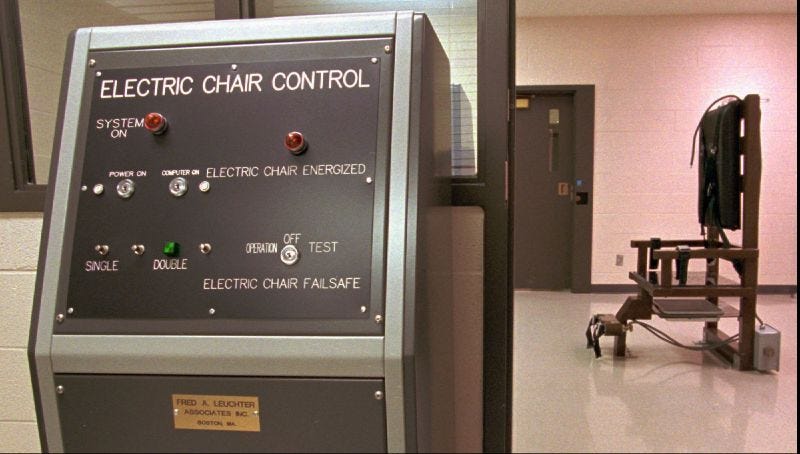
to save him from the Tejano chair.

But as early as central booking,
under the coarse-wool blanket,
unequivocal as the clock it was
that each cogwheel (inkpad tech,
guard, wellness checker too)—

however many years away still
from the casehardened “Heard it
all before, buddy"—could at best
merely reverse empathy’s vector:
“Just doin' my damn job, man."
“Spark” is a stark meditation on the last flicker of human contact within the impersonal machinery of capital punishment. Rather than depicting overt cruelty, the poem centers on a small, almost tender gesture—the warden offering a Marlboro—against the backdrop of an irreversible execution. The poem’s emotional force derives from this contrast: institutional finality framed by ordinary, even humane, exchange.
The opening image is precise. Inmate 999625 does not wave off the cigarette; the hypothetical clause—“might have waived off / the warden’s macabre Marlboro / had he still thought…”—clarifies that earlier in the process, when he still clung to the possibility of manipulating sympathy through “pity-exacting self-mutilation,” he might have refused such gestures as part of a strategy. But that stage has passed. The conditional tense underscores resignation. He now accepts the cigarette not as theater, not as protest, but as the last available human ritual before the “Tejano chair.” The Marlboro becomes both macabre and merciful—macabre because it precedes death, merciful because it acknowledges him as a person rather than a case file.
The poem’s movement backward to “central booking” reveals when hope first began to evaporate. Under the “coarse-wool blanket,” long before appeals were exhausted, he intuited something “unequivocal as the clock.” Time functions here as an indifferent metronome. From the earliest intake procedures—inkpad technician, guard, wellness checker—the system is already in motion. The cogwheel imagery emphasizes that no single actor determines the outcome. Each participant performs a role. The inevitability of execution is embedded not in malice but in structure.
Crucially, the poem does not demonize these figures. It anticipates the eventual hardening—“Heard it all before, buddy”—but frames it as the erosion of empathy over years of repetition. Even before that calcification sets in, the line “Just doin’ my damn job, man” captures a defensive humility. The phrase is neither triumphant nor cruel; it is weary. Empathy’s “vector” is reversed not because staff lack feeling, but because they must redirect it inward to endure their tasks. The bureaucratic apparatus absorbs and redistributes compassion in ways that make it survivable for those inside it.
The title, “Spark,” resonates on multiple levels. It may evoke the electrical spark of execution, but it more subtly gestures toward the spark of humanity that persists even within the condemned and his custodians. The offered cigarette is a spark—literal flame shared between two men in an asymmetrical but recognizably human encounter. It is a fragile acknowledgment that survives even as institutional time closes in.
What the poem ultimately dramatizes is not spectacle but inevitability tempered by small mercies. 999625 understands that no performance—no self-inflicted injury, no dramatic plea—can derail the mechanism once engaged. The last cigarette, then, is not a bargaining chip but a final communion. The poem’s restraint allows this quiet humanity to stand out sharply against the mechanical imagery of clockwork and cogwheels. The spark is small, but it is real.
capital punishment, last cigarette, prison ritual, bureaucratic inevitability, empathy under strain, institutional humanity, death penalty, procedural justice, moral resignation, prison psychology, electric chair, small mercies, poetic minimalism