

Pumps and a Bump
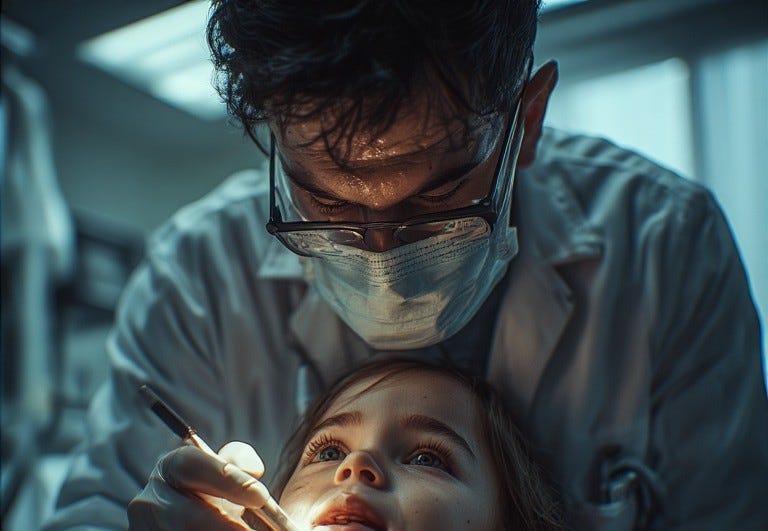
Let’s workshop this piece about a dentist who--with how his hips move with that high-octane of the New Jack era--one might call the M. C. Hammer of Dinosaur Dental, a dental practice for young kids.

SCENT OF THE DAY: Nose Rest Day
Pumps and a Bump
The Sisyphus of sedation dentistry suctioned the patient’s throat, rendered once again mere object in his deep-dipping frenzy to scavenge what had led to pneumonia in others before her. Thoroughness was less his retributive care for a moral agent he had wronged than his way to express that he was done for good now with such wronging (“No more. This’s the last damn time.”)—a promise he had broken too many times.
Not one shot less than all that made the mouth butcher a blowlegged blue had filled the cavity, the least prized but the least damning of the three under his fingers—fingers whose stink of her translated, to no small part of him, as asking for it. And yet he needed to suction it all as if he had not just seconds before risked family and reputation, license and freedom, to fill it up: right leg high like M.C. Hammer’s dog, knee higher—for someone his age—than a Pentecostal miracle; hands overlapped, bottom lip bitten in menace, as if he were air humping to the New Jack of a 90s nightclub; otherwise-arthritic hips, too high energy to be called anything but “violent” (even if abstracted from the World-All and set against pure white), pumping and pumping with the footing-loss frustration of a horse (speed far from the kiddie ditty “one pump, two pump, three pump four”) until at a depth of reckless greed, grooving and grinding at a Slow Jamz tempo, those white hips rolled with that feeling-himself femininity of a man teasing his own nipples, rolled with that gayness of any good lover who savors instead of gobbles—romance whispers included (“Lil fuckin Sleeping Beauty, huh?”).
Was something in him looking to get caught precisely because he had broken the promise again and again, enough times that the Serenity Prayer had swelled into a lifesaver neither silly nor even optional? The child’s tousled hair and dreamy groans, her nasal hood all out of whack like she had just been face fucked by a full-grown man who could give a flying fuck in his rage against having been born, the breathy sighs of his halitosis swirling in the air with the chlorinated gaminess of his climax—he was not dumb. No effort, even if successful in snuffing out all the data visible to courts, could ever cover the rank vibe of predation that his assistant would walk into any second, heels clicking back from a decoy errand for gauze in the supply closet (“Just check the overstock. Top left, I think. Thanks Debbie.”).
“Pumps and a Bump” is a brutal psychological portrait of compulsive predation inside a clinical setting, a poem less interested in external scandal than in the perpetrator’s split consciousness at the moment of repetition. Its central tension lies in the collision between professional ritual and sexual violation: the same hands that suction, sedate, and manage risk are the hands that create the contamination they then frantically try to erase. The poem’s horror comes not from revelation but from simultaneity. The abuser is not later reflecting on what he has done; he is committing the act while already inhabiting the self-disgust, rationalization, and damage control that accompany it.
The opening sentence establishes this divided condition with extraordinary precision. The dentist is “The Sisyphus of sedation dentistry,” a phrase that frames him as trapped in compulsive recurrence rather than singular evil alone. Sisyphus is not merely punished; he is condemned to repetition. That is the poem’s governing psychology. The dentist suctions the patient’s throat in a “deep-dipping frenzy” not because he is ethically restored to care, but because he is trying to remove the evidence of the danger he himself has just introduced. His “thoroughness” is therefore neither medical professionalism nor repentance in any redeeming sense. It is ritualized cleanup, the compulsive counterpart to the compulsive act. The line makes clear that he experiences this thoroughness as a vow to himself—“No more. This’s the last damn time.”—yet the poem immediately strips that vow of seriousness by noting how often it has been broken before. The cycle is not temptation followed by regret; it is violation already embedded in a routine of post-violation self-talk.
The clinical environment sharpens the poem’s depravity because it is a space structured around asymmetry, trust, and incapacitation. The patient is sedated, reduced in his mind to “mere object,” and this reduction is not incidental. Sedation dentistry becomes the enabling frame for the collapse of moral relation. The girl is not encountered as a person in her own right but as a body under his hands, a cavity among other cavities, a site where desire and violation can masquerade as procedure for just long enough to happen. The dental language is crucial here. The “least prized but the least damning of the three under his fingers” collapses anatomical specificity into the logic of clinical handling, showing how professional touch can be internally repurposed into sexual opportunism while retaining the vocabulary of assessment.
The poem’s middle section is remarkable for how it renders the assault not as abstract evil but as movement, style, posture, rhythm—as choreography. The dentist’s body is described in comic, musical, and pop-cultural terms, from M.C. Hammer to slow jams to New Jack swing, and that very excess is part of the poem’s method. The grotesque point is not merely that he is violating the patient, but that his body is still performing for itself, aestheticizing its own excitement. The hips, the stance, the rhythm, the whispered talk—these details reveal narcissism at the center of the violence. Even here, inside criminal violation, he experiences himself as seductive, energetic, “feeling himself.” The poem is therefore not only about predation but about the obscene self-romanticization that can accompany it. The assault is not just physical domination; it is a scene in which he continues to cast himself as active, virile, even erotically expressive.
This is why the poem’s language of femininity and gayness matters. It is not pathologizing either category; rather, it is identifying the way the man imagines his own savoring, his own stylization, his own “romance whispers.” The point is that predation here does not present itself to him as brute ugliness alone. It is wrapped in an erotic self-concept, a fantasy of being not merely a violator but a lover, which makes the violation all the more sickening. “Lil fuckin Sleeping Beauty, huh?” is a perfect example: the fairytale language and tenderness-script are grotesquely overlaid on sedation, rendering the very grammar of romance obscene.
The final paragraph deepens the portrait by introducing not legal fear in the abstract, but the atmosphere of detection. The speaker asks whether something in him is “looking to get caught,” and that question is one of the poem’s most incisive psychological turns. The predator is not stupid; he knows how exposed the scene is. The disordered nasal hood, the tousled hair, the altered air in the room, the returning assistant—these details create an environment saturated with evidence, even if not all of it is evidence in the strict forensic sense. The poem is brilliant on this point: what cannot be fully erased is not just physical residue but “the rank vibe of predation.” That phrase shifts the poem from crime to phenomenology. The assistant may not walk into a courtroom-grade data set, but she walks into a room transformed by what has happened in it. The poem insists that predation leaves an atmosphere.
That atmosphere is what makes the title so effective. “Pumps” names both medical mechanism and sexual rhythm; “bump” suggests residue, detection, complication, pregnancy, or simply the one visible irregularity that turns concealment into risk. The title’s slangy compression mirrors the poem’s larger strategy of fusing clinic and assault into one unbearable field. The result is a poem about contamination at every level: of profession by compulsion, of care by violence, of remorse by repetition, of cleanup by the memory of what cleanup is trying to hide.
predatory psychology, compulsive abuse, sedation dentistry, clinical violation, repetition compulsion, erotic self-delusion, abuse and cleanup, atmosphere of guilt, professional corruption, psychological portrait, standalone poem analysis