

Not Even Angus
Let's workshop this poem about the eros of an iterative self-bargaining that gradually licenses disaster, and all for a payoff as low-grade as a pair of white-trash thighs thundering through Walmart.

SCENT OF THE DAY: L’Oudh, by Tauer
L’Oudh (2018, Andy Tauer)—the pinnacle of oud presentation in the “American style” (Risk could have been a contender if it were not full of amberwoods aromachemicals) and a fragrance that, while currently demoted by the glory of so many other hits, has the claim to fame of at least staying in the top-ten charts for years now despite its linearity and its being mainly a showcase of Laotian oud (or, perhaps more accurately, a Laotian oud accord of which cypriol does a lot of the heavy lifting)—
teleports me to a desert (arid air dusty with Tauer’s atmospheric ambergris, Tauer’s DNA of myrrh-cola incense comparatively muted but discernible) where I find myself—not outside of Marrakech catching wafts of spice from some nearby souk like in L’Air du Desert Marocain but rather alongside some southwestern highway catching wafts of creosote from nearby railroad tracks like in Robert Pirsig’s Zen and the Art of Motorcycle Maintenance—broken down in the high-noon heat (beads of salty sweat, Pepsi too flat and hot to drink, the Honda Super Hawk’s engine too swollen to turn over),
a scene so evocative that it is hard not to see the mirage of heat ripples on the horizon (clear blue sky meeting distant road) as I inhale the road-trip smells of Kerouacian Americana (hours upon hours of this rubberized inertia resolving into the pissy glow of smoked woodchips and subtle greenery until all that remains in the very end is milky sandalwood with fantasy echoes of what came before):
blackened engine oil and burnt clutch and melted rubber (not as prominent to me now with my nose being the equivalent of vulva blown out by a welfare litter of aggressive quantity, but still there), like from tires after doing donuts in the lot of a dead mall (a consequence of birch tar amplifying the smoky-medicinal-inky vetiver and the industrial aromatics of the authentic agarwood oil from Laos);
plus hot leather in the bandaid-mothball direction of several vetiver-patchouli heavyweights (Gucci’s Guilty Absolute, Bianchi’s Black Knight, Opus XI, Tauer’s own Lonestar Memories) and with perhaps the closest aromatic-plus-vibe connection to Opus XI and Gucci Guilty (so much so that I pick up perhaps phantom green-antiseptic sensations, nose clearing terpenes and pinenes, like we can get from the Marjoram of Opus XI or the Cypress of Guicci), only here that bandaid-mothball leather is stamped by tobacco and boosted by a castoreum that drives home the fart-cured aura of long hours of seated ass while also imparting a metallic edge;
plus sunbaked tarmac (this mainly the result of the morel mushrooms and the patchouli and the cypriol and the styrax, which in themselves evoke forest-floor woodiness and boot-tread earthiness, being channeled in a smokey-tarry direction by the oud and the birch tar)—
the overall effect being an extremely unique oud fragrance that, instead of highlighting fermented-woodchip-manure oud like Lao Oud or moldy-blue-cheese oud like Arsalan or grassy-green-vegetal oud like Triad, highlights industrial-rubber oud like Thichilla but with a key difference (aside from the most important to me, which is that Thichilla has more of an annoying super-amber base):
L’Oudh presents a dark burnt rubber of skidding tires in a scorched roadside setting where the florals (jasmine and rose) are ragged and sparse whereas Thichilla presents a bright fungal rubber of stale swim-tube air in a spring floral-rich setting, the vetiver in L’Oudh (especially coupled with the leathery castoreum, the tarry birch, the burnt Laotian oud, the charred cypriol) adding more of a smoky-inky-tarry aroma (bringing it closer to Oud Taiwan) whereas the vetiver in Thichilla (especially coupled with the mossy-musty spikenard and the green-rot Thai oud) adding more of a rooty-musty-vegetal aroma;
the myrrh in L’Oudh (especially coupled with the sweet cistus and the radiant ambergris) adding more of a cola aroma whereas the myrrh in Thichilla (especially coupled with the earthy turmeric and the mossy-musty spikenard and the rooty vetiver) adding an intense bitter fungal quality (a fungal difference not offset even by L’Oudh’s morel mushroom, whose effect leans less toward moldy funk than toward truffle-oil fuminess that deepens the garage-shop character).
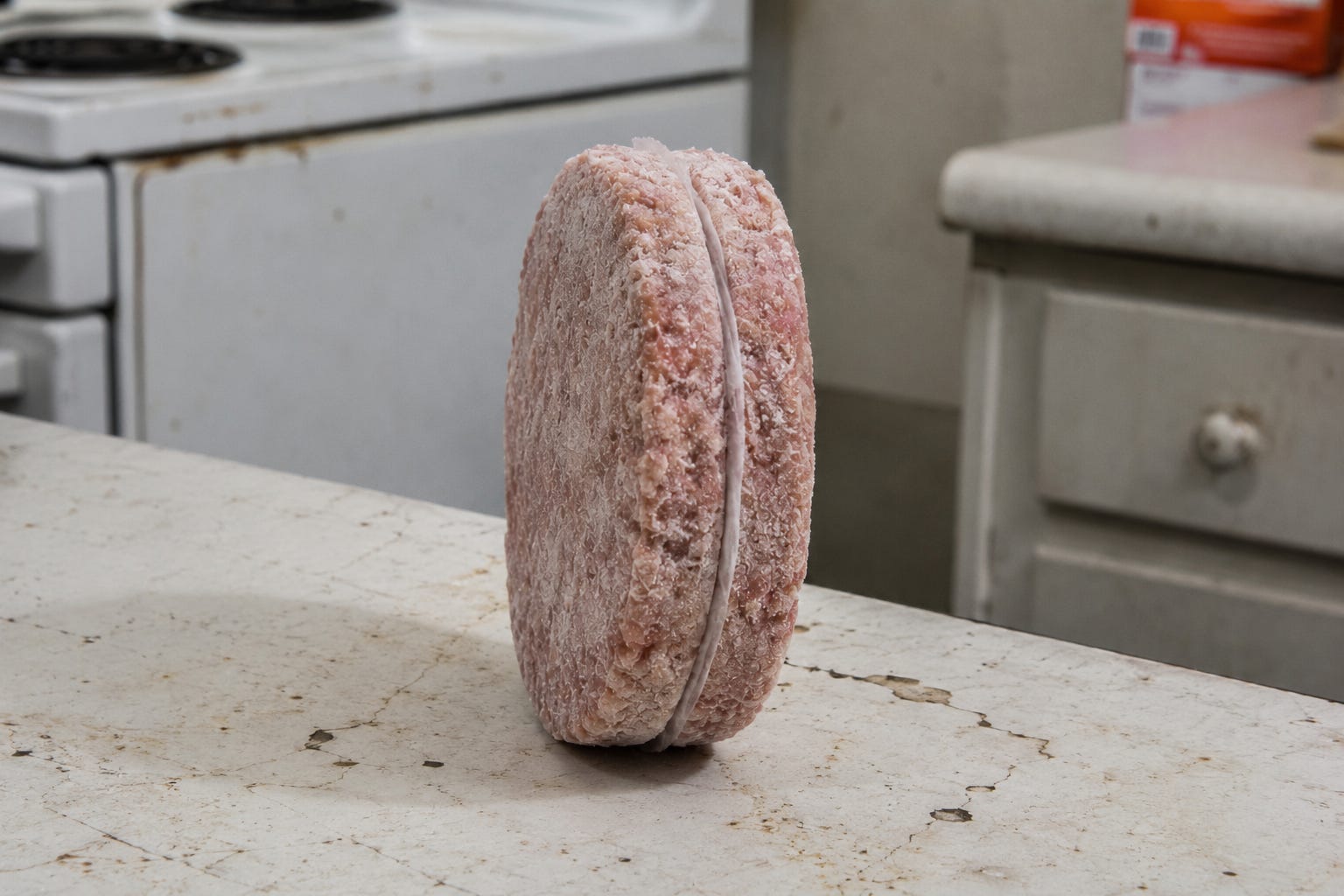
*I was stuck between two titles: (1) “The Eros of Renegotiation,” which focuses on the seductive-sexual nature of self-deception and sliding back on your promises; (2) “Not Even Angus,” which is a cold hard slap of existential irony in that the person died for some mid-grade grocery store anonymous disc of industrial meat. I went with the latter because to highlight the tragedy of trading your heartbeat for meat that is not even angus.
Not Even Angus
	—for my mom

Behold another death by burger
patties fused in frost,
the bloody combo: impatience

plus butcher knife plus
the promise—easy to walk back,
baby step by self-bargaining

baby step (just one more
bend in the cave)—to slant
the force away from your heart.
https://substack.com/home/post/p-193529203
This poem, “Not Even Angus,” is a compact elegy that frames death through the language of small decisions accumulating into irreversible consequence. Its emotional core lies in how an ordinary domestic act—separating frozen burger patties—becomes the site of fatal miscalculation, and how that moment is retrospectively understood as a chain of rationalizations rather than a single error.
The opening line, “Behold another death by burger,” carries a bitter irony. The casual, almost dismissive phrasing reduces tragedy to a category, suggesting both the banality of the setting and the recurrence of such accidents. The image of patties “fused in frost” introduces the physical resistance that initiates the sequence, while “the bloody combo” shifts the tone sharply from mundane inconvenience to violent outcome. The triad—“impatience / plus butcher knife plus / the promise”—frames the event not as random but as a convergence of factors, with “the promise” hinting at the internal assurances that enable risk.
The middle lines deepen this psychological dimension through the language of incremental self-bargaining. “Baby step by self-bargaining / baby step” captures the way one justifies proceeding despite danger, each small concession making the next easier. The metaphor of “one more / bend in the cave” is particularly effective: it evokes both exploration and entrapment, suggesting that the subject moves forward under the illusion of control while actually narrowing the path of escape.
The final line—“to slant / the force away from your heart”—introduces a tragic irony. It implies an awareness of danger and an attempt at precaution, yet the phrasing underscores the insufficiency of that adjustment. The effort to redirect harm becomes part of the sequence that leads to it, reinforcing the poem’s central insight: that fatal outcomes often arise not from ignorance but from misjudged confidence in one’s ability to manage risk.
The dedication “for my mom” reframes the entire piece, transforming what might read as a general meditation into a personal act of mourning. The restraint of the poem—its refusal to elaborate beyond the moment and its logic—heightens this effect. Rather than narrating the loss directly, it reconstructs the chain of thought that made the moment possible, allowing grief to emerge through analysis of the irreversible.
Formally, the poem mirrors its theme. The short lines and incremental phrasing enact the “baby steps” they describe, moving the reader through the sequence with controlled inevitability. The result is a piece that locates tragedy not in dramatic excess but in the quiet, cumulative logic of everyday action.
Not Even Angus, elegy, accident, risk, self-bargaining, domestic tragedy, grief, poetic analysis