

Mercari
Let’s workshop this poem about adults so caught up in their own world, as they watch kids at play around pickup time at a daycare, that they fail to register what in other contexts they would pay for.

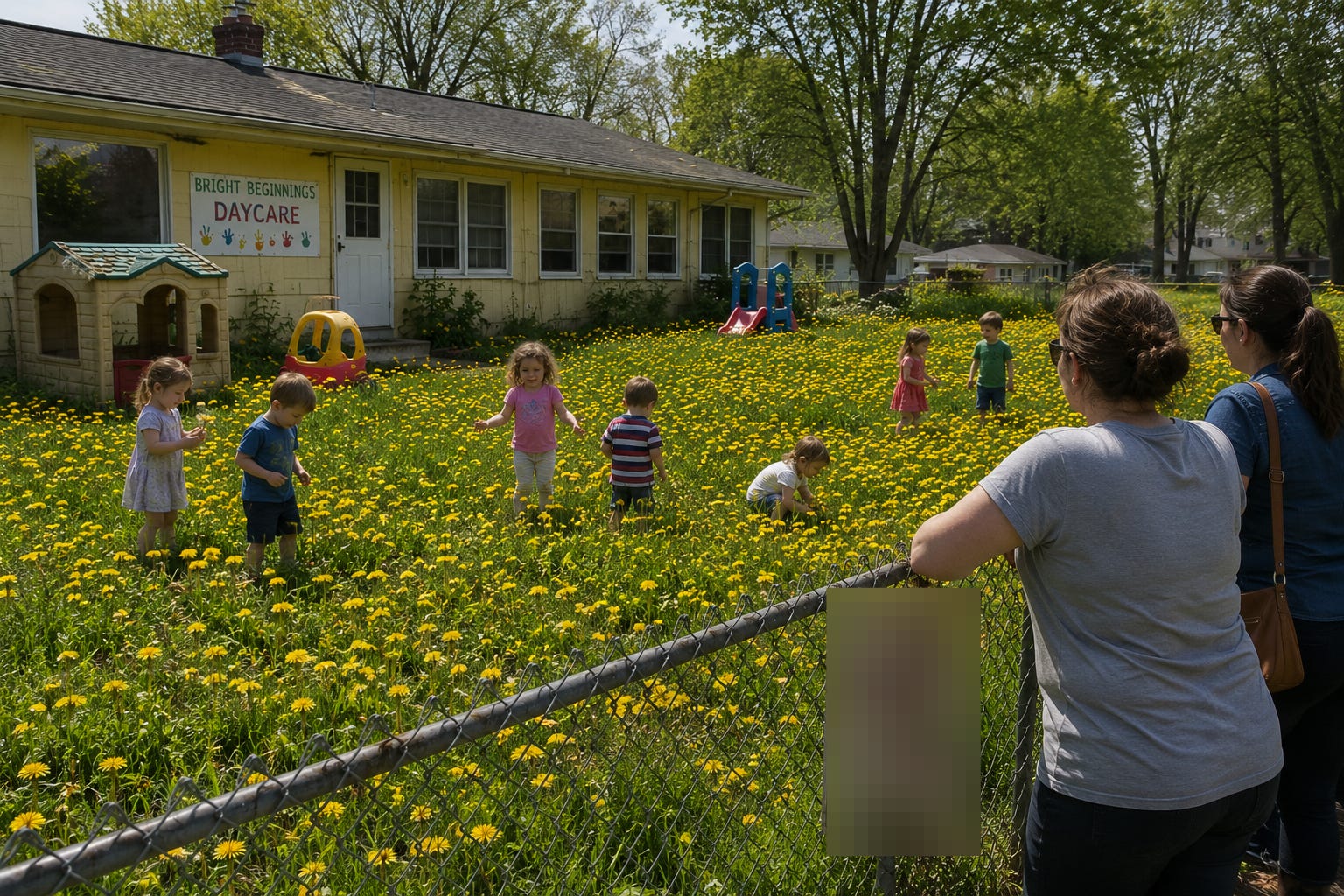
See asterisk commentary below for why I am now redacting my photos. TDLR: perpetual infants get perpetual frost
scent of the day: Narjis Noor, by Elkhaldi (and Tauhid)
Mood-boosting springtime scent of yellow flowers mating in a golden sun—think: weedy daffodil soap. Absolutely stunning doughy nectar and tobacco vibes from the narcissus. I love when flowers go doughy like heliotrope and here the narcissus does just that. It is one of the best in the line. And on my second wear this might be in the running for a top ten spot, which is a big deal in my collection. Vegetal pollen musk that many will associate with artisanal soap. Osmanthus provides as suedy body and ramps up the yellow floral feel with subtle impressions of peach.
My partner hates this fragrance with a passion: said I smell like an old man in an old-age home who has shit and pissed himself repeatedly. She is getting the pigstye resemblance from narcisuss. Pigs give off a compound common to narcissus I think. It was a visceral reaction. This—unfortunately, in light of that—is in running for my favorite Elkhaldi and is vying for my top 20 of all time. It makes sense that it would. It has musk—check. It has yellow florals, which I really like for the nectar and sun and even weediness and leathery they can show. It has a variety of ouds—check. It is animalic (female-taint jasmine, and the furry-pelt Kashmiri musk)—check. It has Persian-style shammama spices—check.
I am tremendously smitten with this one. It brought me back to the first Elkhaldi’s I smelled, which are remain at the top: Civet Regale and Ghazali Finale. The star of the show of course are the florals: fuzzy-peach osmanthus; narcotic-grundle jasmine; shag-tobacco narcissus; spiced-herbs shamama (saffron and bay leaf and definitely cinnamon). But these are grounded in ouds: fermented plum Cambodian; unsweet-tar Burmese oud (very similar to what I get in Mongolian Mriga); woody-incense Vietnamese Oud.
The closest fragrance I have to this is Jinx’s Rayong Fleur (a decant). Both are spicy-soapy yellow floral fragrances anchored in oud (especially cherry-tobacco Cambodian) and musk (especially creamy-leather Kashmiri). Rayong is a nice scent but Narjis does the job better. Rayong goes a bit more weedy and waxy (hipster-arthouse vintage) whereas Narjis Noor goes more petals and musk (authentic-musky vintage)—both things I like. Both go into the territory of grandma dress gentrifier whites (yes, even the “males”) on fixed gear bikes and cowboy boots smelling of yellow floral soap with a sort of vegetative costus-like rootiness. But—with maybe how the spices work with the musk (I don’t know yet)—Narjis goes more like biological woman in that same situation whereas Rayong feels like a trans woman on that same bike—a trans woman ready to ruin the career of any comedian or professor daring to dead name or misgender or state facts and statistics “unsettling for vulnerable populations”; a trans woman bearded to all circus hell and yet dying to use the girl potty at any establishment (if not to ruffle some pedophile juices, then at least to ruffle some political feathers).
The difference comes down to the floral accord that rising from the melange of yellow floral ingredients. The Jinx is more like dandelion whereas the Elkhaldi is more like daffodil (narcissus, narjis). While both dandelion and daffodil are iconic spring florals that share green and yellow floral accords and a mating garden impression buzzing with bees in the sun, their scent profiles diverge in texture and intensity. Dandelions are defined by their bitter weedy edge (which is why the Jinx seems more like a garden overrun by weeds and thereby more in the direction of Parfum d’Empire’s Mal-Aime, Mal-Aime mixed with a bit of that alluring cigarette-ash-pesticide I get from Rasasi’s Tobacco Blaze). Daffodils, on the other hand, are characterized by a more elegant floral sweetness with hay-like undertones. The difference are small between the two fragrances but you can really divide them by the difference between dandelion and daffodil. Dandelion is more bitter and milky and smoky whereas daffodil is more sweet and floral and haylike. Dandelion is more herbal and rugged whereas daffodil is powdery and sophisticated. While dandelion does have honey vibes, the stemminess is font and center. Daffodil on the other hand is much more the petals: honeyed and full of sunshine. Perhaps more import to me is that dandelion—more green, bitter-milky, meadowy, weedy—is not animalic, not especially sexual, whereas daffodil (especially in absolute form) can get heady and musky and sultry. Really you camn distinguish the two on that honey vector. Although both are waxy (reflective of the protective layer over both flowers, a layer that has many fatty acids in common with beeswax), dandelions—sugary, lactonic, pollen-heavy, almost like a talcum powder made to smell like cut grass—are more on the upbeat nectar side of the spectrum (think of when you would rub a classmates are with the head of one in school to mark them with a yellow streak) whereas daffodils—heavy, narcotic, indolic, and with a muskiness and tallow-coated leatheriness that deepens with age—are more on the moody beeswax side of the spectrum.
Another way to put it is like this. It is like the difference between the look and feel of real 70s cinema vs the contemporary hipster odes to that era whose flannel and crab fisherman beanies, whose opiod problems and deckhand Navy tattoos, make them—no matter how real their penchant for eating Vienna sausages and corned beef hash right from the can—just about as blue-collar as Springsteen. The Jinx is the Platonic shadow cast though a hipster lens whereas the Elkhaldi feels closer to the real deal, closer to the eidos. The cinema analogy really does apply to the differences between the two fragrances. The authentic 70s cinema had erratic and organic grain whereas the modern homage had a digital overlay to emulate grain and give that throwback gritty vibe (but which often comes off to perfect in some sense to be authentic: too evenly distributed or whatever). While a real 1975 film might look a bit dusty or washed out in color (desaturated earthy palette), a Tarantino homage to that era will often have hyper-vibrant yellows and reds that look like a 1970s magazine ad rather than a 1970s movie. The modern homages are try-hard (not necessarily bad) and so use all this stylized lighting to scream: this is the 70s: heavy yellow and orange filters with a toss in of audible pops and anamorphic lens flares here and there to mimic the film flaws of the era. And yet because the underlying digital image over which all these 70s-makign filters are overlaid is so sharp, the superimposed “softness” can sometimes feel like a blurry filter rather than a natural optical limit like in the case of the real thing.
Yes, that is the key difference between Rayong Fleur and Narjis Noor. Narjis comes off like the original Shaw Bros Kung Fu film (say, Five Deadly Venoms) whereas Rayong Fleuer comes off like a Tarantino homage or 70s exploitation (say, Kill Bill). That makes good sense in general. The whole Jinx style is that arthouse throwback aesthetic.
If Narjis had more of the civet of the Jinx I think it would be even better. But, despite my impressions of the fragrance (artisanal soap sitting under sun in a yellow floral dominated garden), several people have told me that this already comes off as fecal as it is. So that could be overkill. I have Elkhaldi’s civet paste, though. I could just layer—and yes, that needs to be done.
*My poems almost never directly relate to my perfume of the day. This is an exception. While my perfume of the day is daffodil-centered as opposed to dandelion, they both share that weedy yellow floral aroma.
Mercari

The dandelion riot has moms
looking skeeved out
along the daycare fence (chain link,

extra guilt), but their kids—
twisting stalks, smudging
each other’s forearms yellow—

free into the wind a time rift—
bitter nectar, milky and smoky—
they would buy online.

"Mercari" is a poem about the irrecoverability of childhood sensory experience and the particular modern pathos of knowing that irrecoverability while watching children live inside what has been lost. Its nine lines accomplish something remarkable: they hold two generations in the same physical space and render the absolute perceptual gulf between them without sentimentality or nostalgia, arriving at an image — the dandelion's bitter, milky, smoky nectar released into the wind — that is simultaneously a child's unconscious pleasure and an adult's conscious, purchasable loss.
The title locates the poem's argument before the first line begins. Mercari is a resale marketplace — a platform for buying and selling secondhand goods, the digital economy of recovered objects. Its appearance as title names the adult relationship to childhood experience that the poem will dramatize: the attempt to repurchase, through commerce, what time has made inaccessible. The title does not mock this impulse. It identifies it with the precision of a diagnosis.
The opening image — "the dandelion riot" — establishes the poem's characteristic tonal compression. "Riot" applied to dandelions is simultaneously accurate (the flowers do overwhelm in uncontrolled profusion) and gently comic (the scale mismatch between the word and its referent), but the comedy is not dismissive. The dandelions are genuinely riotous from the children's perspective, genuinely skeeving from the mothers', and the divergence of these responses is the poem's subject in miniature. "Moms / looking skeeved out / along the daycare fence" renders the adult position with affectionate precision — the mild disgust, the sense of disorder, the instinct toward containment. The parenthetical "(chain link, / extra guilt)" is one of the poem's most economical moves: the fence is both literal infrastructure and the poem's symbol of the adult's position outside the children's experience, and "extra guilt" names the specific maternal phenomenology of the daycare drop-off — the guilt of the fence itself, of the separation it enforces.
Against this adult management of the scene, the children simply act: "twisting stalks, smudging / each other's forearms yellow." The verbs are physical and reciprocal — twisting, smudging — and the yellow on the forearms is both mess (from the mothers' perspective) and mark of participation, of being fully inside the experience. What the children are doing with their bodies is what the poem identifies, in its closing lines, as the thing that cannot be purchased.
"Free into the wind a time rift" is the poem's most formally ambitious phrase, and its syntax enacts the release it describes. "Free" functions simultaneously as verb (they free something into the wind) and adjective (the release is free, unencumbered), and "time rift" names what is actually being released: not merely dandelion seeds but a tear in temporal fabric, a gap through which something from another register of experience passes. The children are not releasing seeds. They are releasing the possibility of inhabiting this moment without knowing it will be lost.
"Bitter nectar, milky and smoky" is the poem's sensory center, and its apparent contradiction — bitter and nectar, milky and smoky — is the point. The dandelion's smell and taste are genuinely complex, genuinely contradictory, and the children encounter this complexity without needing to resolve it. They are inside it. The adults remember it, or half-remember it, or recognize it as the kind of sensory experience that once existed and no longer does, not because dandelions have changed but because the perceptual openness that made the experience fully available has closed.
"They would buy online" closes the poem with the quietest possible devastation. The subject of "they" is the mothers — the adults along the fence — and what they would buy online is this: the bitter nectar, the milky smoky complexity, the time rift, the full sensory inhabitation of a moment that their children are living without knowing it is remarkable. Mercari sells secondhand goods. The poem ends on the recognition that what has been lost here cannot actually be listed, cannot actually be shipped, cannot actually be repurchased — that the platform's existence as the poem's title names the attempt while the poem's final image names the attempt's impossibility.
Formally, the poem's nine lines refuse any regular structure, moving instead with the rhythm of observation and recognition — the eye moving from the mothers to the children to the seeds to the loss, each movement enacted in the line breaks. The enjambments consistently open onto something slightly different from what the preceding line suggested, enacting the perceptual surprise that the children experience naturally and the adults can only watch.