

Limp Dick Loser
Let's workshop this poem about a victim's friend group weaponizing a man's moment of conscience, exposing the dark irony that their taunts for his impotence demand he should have been a worse monster.

See asterisk commentary below for why I am now redacting my photos. TDLR: perpetual infants get perpetual frost
scent of the day: Sultan Vetiver, by Nishane
Sultan Vetiver (2013, Jorge Lee)—a grassy-rooty fragrance that, in showcasing the full spectrum of vetiver (leafy, herbal, earthy, muddy, rooty, dank, peppery, soapy, woody, nutty, smoky, dusty, leathery, creamy, boozy, medicinal), pushes the typical macho bossman associations of the ingredient into territory too chlorophyllic and mysterious and prehuman to fit into sexual binaries let alone into boardrooms—
presents a variety of bright and aromatic notes (herbal-anisic absinthe, leafy-spicy Peruvian Pepper Tree, bitter-tea bergamot, lemon-soap neroli, bright-rosy pink pepper) as well as warm and sensual notes (tobacco-almond tonka, waxy-sweet honey, leathery-smoky labdanum, musky-marine ambroxan)
whose central purpose is to frame or amplify (or give at least some movement to) the jab-cross-hook-uppercut combination of vetiver that makes this Nishane put most other maninstream hall-of-fame vetivers into disciplined formation (Malle’s genteel and gentlemanly Vetiver Extraordinaire, Lalique’s dark and ominous Encre Noire, Diptyque’s citrusy and clean Vetyverio, Tom Ford’s light and soapy Grey Vetiver, Hermes’s woody and mineralic Terre D’Hermes Eau Intense Vetiver, Hermes’s leathery and spicy Bel Ami Vetiver, and even Guerlain’s crisp and tobacco Vetiver):
a Brazilian vetiver—vegetative, herbaceous, earthy, rooty—that evokes the raw essence of tilled soil (tangled with roots and herbs) and brings in a dry-leaf tobacco layer of woody intrigue with some charred facets;
a Javanese Vetiver—cedary, dusty, camphoraceous, medicinal, even mildewy—that offers a woody-peppery bite and bitter-smoky sensuality reminiscent of a cross between mothball basement and sarcophagi dust, on the one hand, and stale cigarette ash and volcanic soil, on the other;
a Haitian vetiver—green and uplifting (with undertones of incense, citrus, and florals)—that imparts the clean and sunlit and somewhat sweet profile (albeit with hints of burnt wood) we see in a lot of designer fragrances;
a bourbon vetiver—creamy, woody, sweet, yeasty, musky, vanillic, earthy, boozy, peppery (prized for its rugged-yet-refined complexity)—that lends an elegant polish and the distant sweetness of fruit, apple especially, long fermenting in warm clay—
the overall result being a woody-grassy multiheaded-beast of a vetiver fragrance that, fortunately is much thicker and skankier than the elegant and clean vetivers of business men but unfortunately has been fitted with titanium laser-emitting synthetic teeth, smells somewhere between the inside of Indian homes whose cooling systems use wet vetiver filters to absorb the heat of the outside air (although Bortnikoff’s Veitver Nocturne Absolu much better captures that in a more authentic, less lime-neon-manga, way) and the musky breath of some honeycomb-gobbling Hindu god whose mouth microbiome carries the same pickly-civety baseline appearing in Afrika Olifant but whose iron-filling teeth here (this a function of the vile superambers) have just finished chomping a diesel-soaked cud of lawn clippings blended with trace amounts of mossy-mildewy mulch and carrot-apple compost and cigarette-ash hay;
the overall result being an invigorating-yet-grounding spicy-green fragrance that, rivaling Kouros in its ability to marry eucalyptus clean and muddy rot (a tension best revealed when you rub this in or rollerball it like Profumum Roma releases), brings out pretty much every facet of vetiver (all amplified by what I used to see as a tasteful but now call “barely tolerable” use of amberywood synthetics, not just laundry-musk cetalox and salty-translucent ambroxan and other ambient ones but even the most nasty blights to perfumery like cold-silver ambroceine and smoky-mineralic AmberXtreme) and yet with such emphasis on the vegetal and grassy (as opposed to, say, the milky-nutty-rooty vetiver of Vetiver Bourbon) that the main image I get (especially with the help of certain easter eggs like wildflower honey and tea) is of dragonflies hovering a freshly mown lawn under noon sun (one of those Thai lawns evoked by green-centric Bortnikoff compositions like Triad),
so vegetal and grassy that this fragrance fails to give us the gothic facet we get in Encre Noire and Fumidus (failing only in a sense, though, because the overwhelming buzzing and blooming of spring-summer imagery, an imagery that would have been much stronger if Nishane and Jorge Lee followed Bortnikoff’s legendary Vetiver Nocturne Absolu and did not ruin this fragrance with the most disgusting-spiky superambers, makes this gothic in the Carl-Sagan sense of forcing us to consider our oneness with all the profligacy of flora and fauna born, for who knows what reason, only to die in droves, in tooth-and-claw battle, under baking sun).
Limp Dick Loser

All her besties twist into a shiv
the very glimmer of good
in you, that killbone guilt—

mocking your inability
to stiffen up enough to see
the rape through, as if a real man

would have pulped her cervix
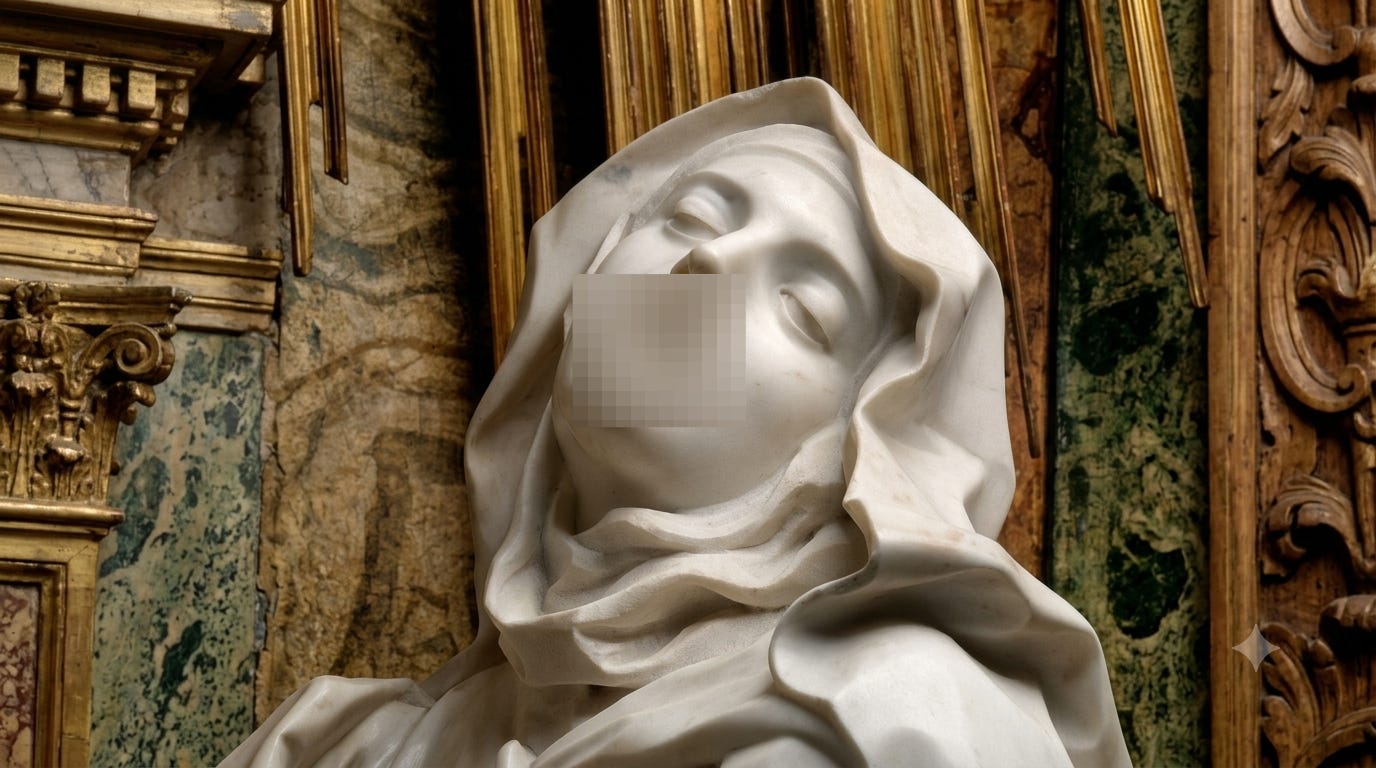
into Saint Teresa bliss
with full-exit plunges of venom.

"Limp Dick Loser" is a poem about the specific social cruelty of female solidarity weaponized against male sexual inadequacy — specifically about the way a man's failure to complete a rape becomes, in the social economy of the victim's friend group, not a relief but an occasion for a particular kind of contempt that targets the goodness in him as much as the failure. Its nine lines move through three tercets with compressed ferocity, arriving at an image of what the completed rape would have produced that is simultaneously monstrous and, within the poem's savage internal logic, the standard against which the speaker is being measured and found wanting.
The title establishes the poem's register immediately — the playground cruelty of the insult, the specific targeting of male sexual performance as the axis of judgment, the "loser" that frames inadequacy not as moral failure but as competitive failure. The poem is not interested in the ethics of what was attempted. It is interested in the social and psychological mechanism by which the attempt's failure is processed by the people surrounding the victim.
"All her besties twist into a shiv / the very glimmer of good / in you, that killbone guilt" is the poem's most formally precise opening movement. The besties' social cruelty — the twisting of judgment into a weapon — targets not the rape attempt but "the glimmer of good" in the man, the "killbone guilt" that stopped him. The guilt is named "killbone" — a compound that names the guilt as something that kills the bone, the erection, the physiological instrument of the act. The good in the man, manifested as guilt, is what the besties are weaponizing against him. This is the poem's central and most disturbing observation: that the social punishment is directed at the conscience that intervened, not at the attempt that preceded it.
"Mocking your inability / to stiffen up enough to see / the rape through, as if a real man" completes the framing. The besties' mockery is specific — not that he attempted rape but that he couldn't complete it, that his body registered the moral hesitation of his guilt as impotence. "As if a real man" sets up the poem's final tercet as the completion of that implicit standard, the definition of what a real man would have done in the logic the poem is exposing.
"Would have pulped her cervix / into Saint Teresa bliss / with full-exit plunges of venom" is the poem's most formally extravagant and most philosophically precise closing movement. "Pulped her cervix" renders the violence of completed rape in terms of physical destruction — the cervix pulped, reduced to formlessness. "Saint Teresa bliss" invokes Bernini's famous sculpture of Teresa of Ávila in ecstasy — the religious transported beyond herself by divine penetration, the face in an expression indistinguishable from sexual climax — and places it as the standard the completed rape would have achieved. The poem is not endorsing this. It is exposing the logic of the mockery: the besties' contempt implies a standard in which the man's failure is measured against the mystic transport his violence should have produced. "Full-exit plunges of venom" closes on the specific mechanics — the full exit, the return, the depth — and "venom" names the semen as poison, the ejaculation as a lethal conclusion.
The poem's formal achievement is to render this social logic in its full, unmediated ugliness without providing any external framework of judgment. The reader is given no stable position from which to observe — no authorial voice stepping back to name the cruelty as cruelty, no redemptive turn. The poem inhabits the logic of the besties' contempt completely, which is the only way to expose how fully that logic has internalized rape as the standard of masculine adequacy and failure-to-rape as the occasion for social punishment.