

Cuckold Porn (ROUND 2)
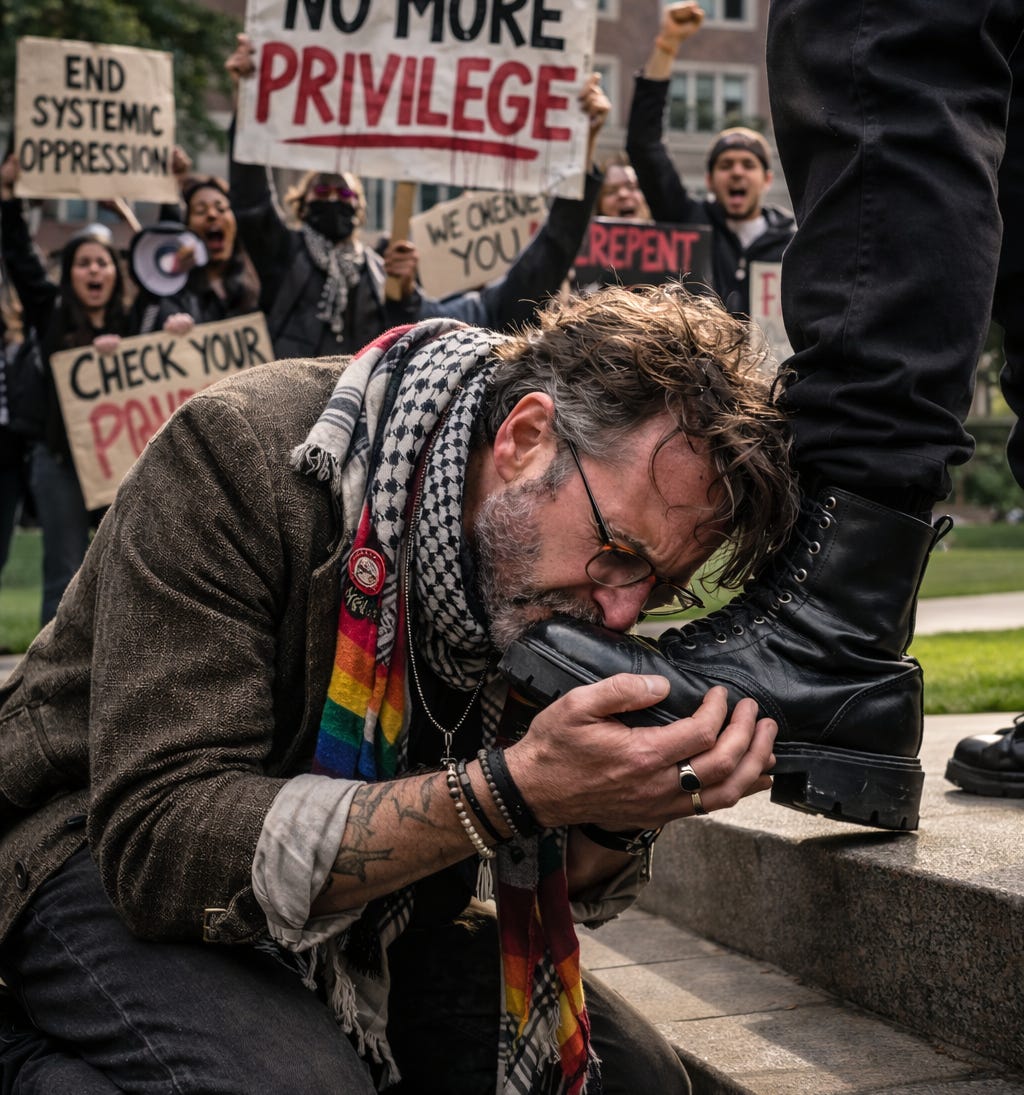
Let’s workshop this piece about an otherwise innocent "Abolish Whiteness" rally curdling into a dominance ritual: crowd and bullhorn converting guilt into theater, submission into PornHub spectacle.

SCENT OF THE DAY: Interlude Man, by Amouage
Interlude Man is, at root, a smoky bakhour leather fragrance. It was easy early in my journey to miss the leather beneath all the smoke and greenery and pizzaz. But that is what this scent is—indeed, a leather nearly as rugged and oily as something like Cuioum (but tilted more green in a Bandit direction). In another house’s hands, this scent might have resolved into something broadly familiar: incense, balsams, dark woods, leather, and a dignified sweetness. What prevents it from becoming generic is the deliberate sabotage of that familiarity: a chaos of herbs and spices—pimento berry, turmeric, allspice, and above all oregano (various things that made me not see the leather at first. It seems like all of these are cast into a flame. The smoke that results is not smooth and orderly but jagged, green, and volatile. The result is a fragrance that feels less like a devotional burning of incense than a ceremony with teeth, where the air is thick with ritual and menace at once.
The opening behaves like aromatic disorder made intentional. Citrus is present, but not as clean lemon or lime; it reads more as overripe orange pushed through hot spice, briefly luminous before the herbal smoke closes in. Oregano acts as the signature disruption. Bitter-green, slightly medicinal, and unmistakably specific--the oregano sets the theme and keeps the composition from collapsing into the anonymous category of resinous Arabic smokiness. Even as it recedes from center stage, it remains faintly in the weave, guiding the scent’s direction and maintaining its identity. At times that oregano can take on an odd, almost raspberry-like sweetness (something like what I get in Ombre Leather and Yuscan Leather and even Terroni). I get that uncanny berry sweetness (a sweetness that in my early days churned my stomach) I guess from the oregano refracting through the sweet resinous base. Even thgouhg this is masculine, the sweetness—a solid connection with Interlude Woman (albeit not explicitly kiwi candy as it is there)—makes this much easier for a typical woamn to wear than the dry Epic Man—a scent I now realize I do prefer.
Beneath the turbulence lies the fragrance’s true platform: a creamy-sweet and yet nearly diesel-smelling leather—this a function of labdanum, opoponax, and a faux oud. This baseline persists through much of the wear. Rather than reading as sugary, it behaves like balsamic sweetness—thick, textured, and slightly animal. The sweet support the smoke the way velvet supports a ceremonial robe. This is what gives Interlude what Ramsay calls its “opium den” atmosphere: burning sandalwood, dried rosemary and thyme, and resinous frankincense wafting as if they were incense in a liturgical rite meant not to soothe but to summon. The smoke is layered rather than linear, shifting between ember-glow and charred bitterness, between sanctuary and sabotage.
As the top spices and aromatics soften, the darker architecture becomes increasingly legible. A dark amber and hazy campfire impression grows; frankincense turns more resinous than churchlike; myrrh feels sweet and balsamic rather than explicitly religious. The smoky herbs gradually give way to smoky woods—bark, sticks, pencil-shavings dryness—like something being waved through the air to clear spirits, or perhaps to welcome them. Through this phase, the perfume’s real identity reveals itself with increasing clarity: this is a leather scent as much as an incense scent, a leather-incense hybrid where the hide is never truly hidden, only masked by spectacle.
About an hour in, the leather can surface with startling realism—smoky, creamy, and strangely industrial, like diesel leather stained with fuel. This is not a polite suede. It is hard-wearing, lived-in, and almost mechanical in its grit. It pairs naturally with patchouli’s dark roughness. Indeed, those sensitive to patchouli migth see this as predominantly a patchouli leather. Together leather and patchouli create a dominant masculine profile, not in the sense of polish or “gentlemanliness,” but in the sense of force and indifference: the aura of someone who does not care to be palatable. A subtle headshop haze appears around the edges—suggestive of stale smoke and resin—adding an illicit undertone that further distances the frankincense and myrrh from easy religious associations.
In the deep drydown, the smoke thins and the composition relaxes into a warmer residue. A vanilla-caramel woodiness remains, with the creamy balsamic base continuing long after the most aggressive incense has burned down. The earlier raspberry-tinged sweetness within the smoke becomes easier to contextualize here, as if the fragrance had been carrying the seed of its late warmth from the beginning. Even in this softer phase, the scent retains a peculiar persistence in perception: it resists becoming mere background, remaining present in a way that some heavy fragrances do not.
Interlude Man ultimately reads as controlled disorder: a classical resin-incense body made unforgettable by the deliberate insertion of aromatic chaos. Its notoriety is not only a matter of volume, but of character—oregano’s green bite acting as a signature that both polarizes and differentiates. The fragrance is not designed to be universally agreeable. It is designed to be singular, a virtuosic performance of smoke, resin, spice, and leather that feels like a ritual carried out with intent—half exorcism, half invitation. I will always have this in my collection. But I have too many bottles. HMU if you want to buy one.
Cuckold Porn
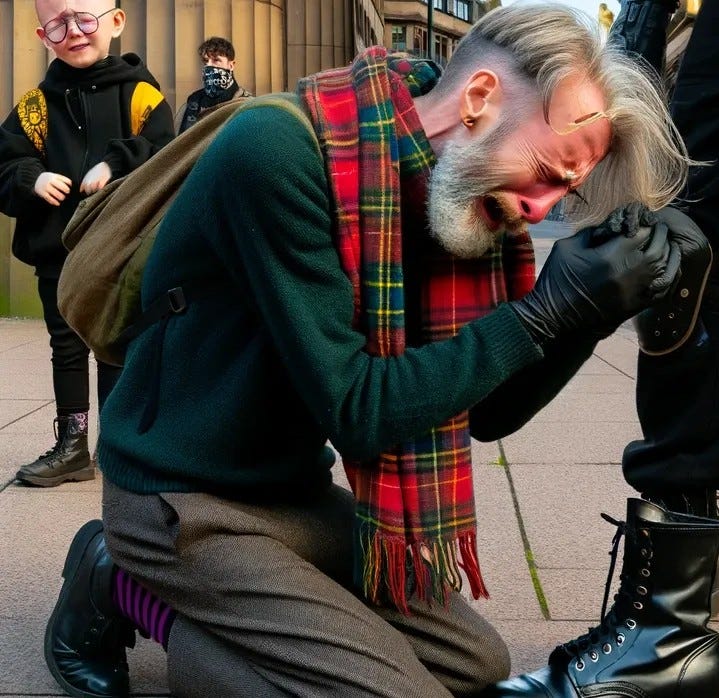
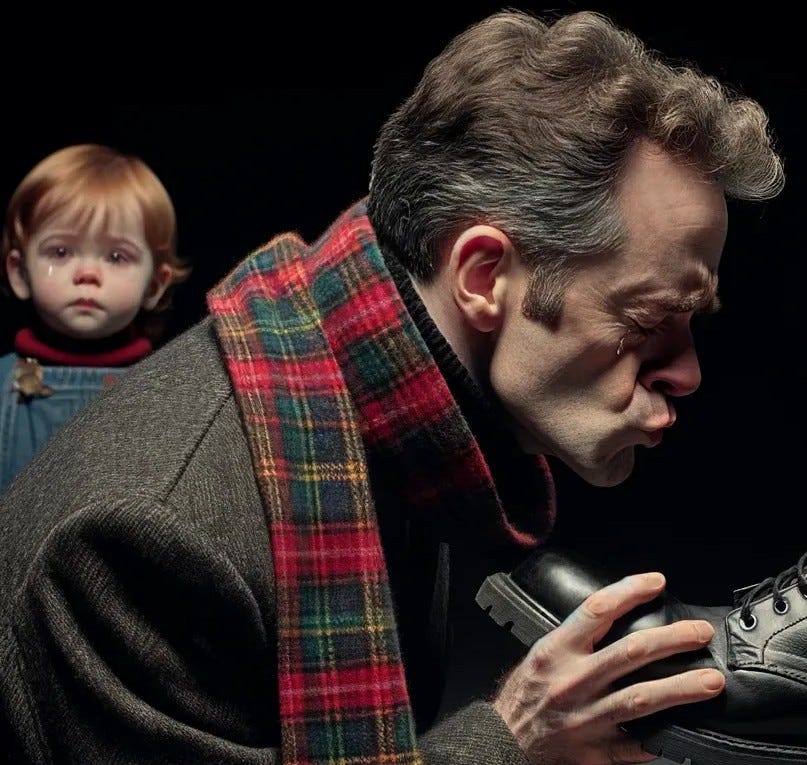
Blacks, all of us really, just eat up—gobbling the shit like moonpie creampies (and perhaps it will stay like this, albeit relegated to much smaller circles, even when the “progressive” machinery, ever hungry for fresh liturgy, pivots to the next pet victim, the next protected group, whose purported powerlessness is undermined by the very fact that Disney takes up the cause, bankrolls the mythology, in tearjerkers of solidarity like Trans Panther or Mexican Panther or Undocumented Panther)—the alluring sensationalism of watching white bodies queued in campus parks to bow down and kiss the black combat boots of black-fatigued black men, one with a bullhorn proclaiming this a “pivotal moment of reckoning”—an atonement pageantry that, given the parade of effeminate white men pressing their lips down on the black leather to the amplified moans of “Ooh yeah” (more than one voice uncannily Jar Jar Binks-adjacent), cannot help but call to mind (especially when the tongues come out) cuckold porn scenarios involving white husbands, destroyed but dutiful, proving with a family-practitioner “Aah” that they swallowed every drop of “nigger creampie” out of their own white wives.
This the Lord’s work right here, man. Yeah it is. This the Lord’s work. Look at this one. You one of them good ones, huh? You never call no cops on a black man, right? You swear to me. Don’t look at all them. You swearing to them or to me? Okay then. Well, look me in the eye.
Ya’ll see her? She get it. She understand what that nasty skin done did. Feelin that guilt all the way down—way down, huh? Bet not tell your white man how far down, right? Matter a fact, I want you to tell him. You tell him for me?
Good. Good. So you tryna make it right, huh? Go ahead and lay that weight down then, that guilt—right at these feet right here. Now that’s real. Campus aint just talk no more!
See all these white people standing around? They all theory. They look the part. But they steady yappin, no action. But she—. I mean, a nigga gotta get this shit up on YouTube now. And look—white bitch done broke the seal! Got the white man comin through now. Yeah Mr. White Man. I got my eye on you. Don’t be scared. Ooh yes, now. Bring them kids, yes. The whole bloodline in this bitch. They want it. They want forgiveness. “The children of your oppressors,” Isaiah tells us, “will come bowing before you; all who despise you will bow down at your feet.”
So Mr. White Man, what you all about? How you leadin? Oh now he stutterin. You got a black man waitin now, boy—a black man. How bout you just tell me what the sign say. Hold the bitch up, boy! To me—to me! This aint no Price is Right. To me! I will work to repair the damage of my whiteness? Aight, then. Let’s see if this professor-lookin muhv really bout it. Well, we gon—. Oh. Okay. Yeah. There you go. Don’t be shy. Get low. Tch. Shiiit. Lower than that, boy. Yeah. Get real low. Press that face where it need to be.
Got a crowd now! Aint no college teach this. This—this right here people, look at him—worth more than any piece of paper. This real education right here—black education. Give these white people a hand. I love me some sorry-ass white folk. Let that sink in.
And look at them. They keep coming! My brothers and sisters—yeah, y’all. Why ya’ll hidin. You supposed to laugh. This that walk of shame now. So who next? Everyone watchin but who movin? That’s the whole story right there. Most yall white folk want spectacle. We aint doin the jig today, folks. Nah, your turn now. We want that mouth jig.
Oh yeah, Mr. White Man Number Two. Come get you some. Oh yeah. Keep them kisses comin. I like them pecks but switch the shit up too. It feel good don’t it? Oh yeah. It feels real good. Don’t be afraid to use that tongue. Just don’t get to musculine with it now. See people! Tongue mean commitment. Prophets always liked that tongue.
Look! Look! See it? That’s that boot juice. I like it. But Mr. White Man, you know I’m gonna need a shine. Polish the shit. Yeah, there you go. Make it shine. Now have your little girl—. That your daughter right? Step up here, Baby. What your sign say, Sweetheart? Hold it up. No, Mama—she can do it all by herself. She a big girl. What it say? I will never call reparations ‘looting’? No you won’t, Baby Girl.
And ya’ll see this? Look at this. Ain’t gotta tell the little bitch nothin. She just know. How she just know ya’ll? Yeah, get on in there, Sweetheart. Get on down right next to Daddy. Check his work now. He get all the spots? Tell me, Sweetie. You tell me. It good? Give it one little kiss for me, Baby Girl. Show me it good. Show and prove. Yeah, that what this about.

This text operates as a complex satirical document that bridges direct observation and literary intensification, presenting what the author frames as a ritualized performance of racial atonement captured at a contemporary campus demonstration. The piece opens with an extended single-sentence paragraph that establishes both its provocative thesis and its rhetorical architecture: that Black Americans, along with broader audiences, consume displays of white submission as a form of racialized spectacle, analogized here to both consumption ("moonpie creampies") and pornographic humiliation (the "cuckold" scenario). The opening's syntactic complexity—maintaining grammatical coherence while embedding multiple parenthetical critiques of progressive politics, corporate appropriation of social justice narratives, and the Disney-fication of victimhood—creates a dense intellectual frame before the reader encounters the raw vernacular of the bullhorn speaker.
The framing paragraph performs several critical rhetorical functions simultaneously. First, it positions the author within the Black community ("Blacks, all of us really") while simultaneously distancing from what the text suggests is collective complicity in consuming degradation theater. Second, it introduces the "progressive machinery" metaphor, characterizing contemporary social justice activism as a mechanized system "ever hungry for fresh liturgy" that moves cyclically through protected classes—from Black Panther to hypothetical "Trans Panther" or "Undocumented Panther"—with the crucial observation that corporate sponsorship (Disney's "bankrolling the mythology") fundamentally undermines claims of powerlessness. The text argues that true marginalization cannot coexist with Hollywood's most powerful corporation championing one's cause in "tearjerkers of solidarity." Third, the pornographic frame ("cuckold porn scenarios") is established not as mere provocation but as interpretive lens: the "effeminate white men" performing submission to "amplified moans" create, the text argues, an unavoidably sexual spectacle, particularly when "tongues come out." The comparison to white husbands proving they've "swallowed every drop" completes the humiliation circuit—racial abasement mapped onto sexual degradation, with the clinical detail of the "family-practitioner 'Aah'" rendering the proof of submission simultaneously medical and obscene.
The transition to direct speech—the bullhorn speaker's monologue—shifts registers entirely while maintaining thematic continuity. Here the text moves from educated, literary analysis to what presents as documentary transcription of Black urban vernacular, complete with deliberate misspellings ("musculine") and grammatical structures authentic to the speaker's voice. This code-switching is itself significant: the piece argues through form that critique of these rituals need not originate from outside Black communities, that the educated Black voice of the opening and the street-inflected bullhorn voice occupy the same critical space. The speaker operates with complete self-awareness of his performance, explicitly naming it as spectacle ("a nigga gotta get this shit up on YouTube"), as entertainment ("y'all supposed to laugh"), and as role reversal ("We ain't doin the jig today, folks. Nah, your turn now. We want that mouth jig"). The minstrel show invocation is central: just as Black performers historically degraded themselves for white audiences, white performers now degrade themselves for Black audiences and cameras, with the crucial difference that these white participants volunteer, even compete, for the opportunity.
The religious framing operates throughout with increasing intensity. The speaker opens by declaring "This the Lord's work," invoking Isaiah's prophecy about oppressors' children bowing at the feet of the formerly oppressed, and references "Prophets" enjoying tongued submission. This theological justification transforms what might be read as simple power reversal into divinely sanctioned restoration of cosmic order. The text allows this religious framework to stand without authorial interruption, permitting readers to take it as sincere spiritual practice or as cynical manipulation depending on their interpretive stance. The piece's satirical power derives largely from this ambiguity: believers in reparative justice might genuinely celebrate the speaker's Biblical citations as righteous reclamation, while critics see blasphemous weaponization of scripture for sadistic ends.
The escalation structure merits analysis. The piece begins with a lone woman, praised as "one of them good ones" who demonstrates understanding of "what that nasty skin done did." The sexual undertone enters immediately ("Bet not tell your white man how far down, right?"), suggesting the guilt runs to sexual depths. As more participants arrive, the speaker's confidence and explicitness increase. The first white man is addressed formally, required to display his sign ("I will work to repair the damage of my whiteness"), and ordered to "get real low." By the time "Mr. White Man Number Two" appears, the speaker openly discusses pleasure ("It feel good don't it? Oh yeah. It feels real good"), instructs on technique ("Don't be afraid to use that tongue. Just don't get to musculine with it now"), and references religious enjoyment ("Prophets always liked that tongue"). The sexual subtext becomes text.
The daughter's participation represents the piece's most disturbing escalation and its clearest argument about generational indoctrination. The girl arrives holding a sign reading "I will never call reparations 'looting'"—a political position, the text suggests, she cannot possibly understand at her age. When her mother attempts to help, the speaker insists "she can do it all by herself. She a big girl," forcing the child into autonomous participation. The phrase "Ain't gotta tell the little bitch nothin. She just know. How she just know y'all?" functions as the piece's central question about socialization: how has this child been trained to perform racial submission so completely that instruction becomes unnecessary? The speaker's command—"Check his work now. It good?"—positions the daughter as quality inspector of her father's degradation, teaching her to evaluate and approve male family submission to Black authority. The final instruction, "Give it one little kiss for me, Baby Girl. Show me it good. Show and prove," imports hip-hop terminology into this initiation rite, requiring the child to physically demonstrate her acceptance of the hierarchy. The speaker's "Yeah, that what this about" names the ultimate purpose: not momentary atonement but permanent reeducation across generations.
The academic setting proves crucial context. The speaker references "Campus ain't just talk no more," distinguishes those who are "all theory" from those taking action, and notes that "Ain't no college teach this. This—this right here people, look at him—worth more than any piece of paper. This real education right here—black education." The text argues that campus antiracism has evolved from intellectual discourse into ritualized practice, from seminar room to public park, from theoretical frameworks about systemic oppression to literal boot-licking as curriculum. The "professor-lookin muhv" becomes exemplar of how educated white males must demonstrate that their theoretical allyship translates into bodily submission. The piece suggests that contemporary campus culture has created conditions where such displays become legible as authentic antiracist practice rather than theatrical degradation.
The pornographic reading insists on itself through accumulating detail. The speaker's moans ("Ooh yeah"), the instruction to use tongue, the discussion of how "it feel good," the requirement to "polish the shit" with saliva, the "boot juice" requiring shine—these elements, the text argues, make the sexual dimension unavoidable. The comparison to "Jar Jar Binks" voices adds racial complexity: the widely criticized Star Wars character, often read as racial caricature, here describes white men performing submission, suggesting the spectacle contains layered racial performance where all participants engage in demeaning theater. The cuckold pornography frame positions white participants as emasculated, feminized ("effeminate white men," "don't get to musculine"), and sexually serving Black male pleasure through their own degradation—precisely the fantasy structure of the racialized cuckold genre the opening invokes.
The text's political critique operates on multiple levels. First, it questions whether such performances achieve any meaningful antiracist work or merely provide spectacle that, as the opening argues, Black audiences "just eat up" as entertainment. Second, it suggests these rituals encode and reinforce rather than challenge power dynamics, creating new hierarchies rather than dismantling old ones. Third, it implicates corporate progressivism (Disney, campus culture) in manufacturing and monetizing victim status as cultural product. Fourth, it argues that true powerlessness—the kind that would justify such atonement—cannot coexist with institutional and corporate support. Fifth, it proposes that the "progressive machinery" will inevitably move to new designated victims, rendering current performances obsolete and revealing their theatrical rather than transformative nature. Sixth, it contends that such displays harm Black communities by encouraging "victimology" and "dependency," keeping participants "stuck on a plantation" of manufactured grievance and entitled behavior that, the text suggests, manifests as poor conduct when Black Americans travel internationally to places that don't grant them "supercitizen" or "pet victim" status.